❌

Reading view

Everybody panic: A Valve developer said "HLX" in public

Gamers still hoping against hope for a true follow-up to Half-Life 2 (after so, so many years) may remember last year's flurry of speculation that Half-Life 3 was finally nearing completion. Amid all those rumors, though, we never got any official sign from anyone inside Valve that a Half-Life project was currently in development.

That changed this week thanks to an apparent slip-up during a panel at GameSoundCon, an industry conference devoted to "the art, technology, and business of game audio." In a panel devoted to Valve's use of open audio engines (captured in this Vimeo clip), Valve composer and audio artist Mike Morasky let an interesting string of three letters slip while talking about the way the company implements high dynamic range (HDR) audio:

Our HDR system is basically that's one of the three pieces that come together to make an HDR that you can easily optimize. And in fact, I think Deadlock has their own version of HDR. HLX has its own version, so on and so forth [emphasis added].

"HLX," of course, has been widely reported as the internal code name for Valve's next Half-Life project. The codename has shown up in Valve engine code since at least 2024, but it has never been referenced in public by a Valve employee until now (though Morasky was responsible for a close call in an interview last year).


Read full article

Comments

© knowyourmeme.com

  •  

Switch 2 security takes a hit as hackers unlock homebrew access

A security researcher has demonstrated a software-only partial jailbreak of the Switch 2, gaining "userland" access that he says "lets us run homebrew, reverse engineer and mod Switch 2 games, back up save files off the Switch, and access most of the Switch 2’s peripherals through MMIO."

The hack relies on the original Switch version of SmileBasic 4, the latest in a long-running series of programming environments and interpreters that run on Nintendo hardware. The so-called "tethered" hack also requires access to a macOS or Linux PC on the same network to run a node.js package that helps enable privileged system access.

Researcher Sammy Hajhamid writes that he used OpenAI's Codex to poke at SmileBasic's language interpreter, using a custom harness that could send USB commands to the system and view results via HDMI (as well as power cycling via a Bluetooth light switch flipping device). After "substantial effort for ~2 weeks," that harness discovered a 32-bit integer overflow that occurs when removing items from an array in SmileBasic. That error gives access to an array pointer, which in turn allows read-and-write access to portions of system memory.

Read full article

Comments

© Pepsipu.com

  •  

Leaked Mass Effect: Universe trailer gives a taste of what we're all missing

Those mourning yesterday's shuttering of highly praised and influential developer BioWare also had to deal with the cancellation of the next Mass Effect game, which was first teased back in 2020. Today, we got our best look at what that game could have been with a short, leaked trailer for Mass Effect: Universe.

In the roughly two-minute montage—which describes itself as "in-engine footage from our small team" that "uses our pre-production assets"—an ex-military officer wearing an N7 trenchcoat (similar to the one seen in that 2020 teaser) encounters an Asari at a bar. He talks of his frustration with military life—"by the time you put out one fire, another had already started"—before discussing his new line of work "stopping [the fires] before they start" and "making the choices no one else is willing to make. Going where others are afraid to go."

Mass Effect: Universe Trailer
by
u/Random_Hyabusa_Ninja in
masseffect

Read full article

Comments

© Reddit

  •  

This emulator reimagines Nintendo’s Virtual Boy with a full color display

Last year, we reported on Red Viper, a Virtual Boy emulator that added a splash of Super Game Boy-style color to Nintendo's famously failed red-on-black "portable" 3D headset from the '90s. Now, a new emulation experiment, VBoy Color, has taken the concept to a higher level, using a tile-based palette system that allows for many more distinct colors in each individual Virtual Boy frame.

Rather than simply replacing the Virtual Boy's four shades of red with four different colors, VBoy Color's readme files explain how the emulator's game-specific Color Packs can assign a distinct four-color palette to each 8x8 tile in a Virtual Boy scene. That means the emulator can differentiate between green pipes, grey platforms, and red brick wall in Mario Clash, for instance, even though all those in-game objects share the same overlapping red hues in the original game.

The Game Boy Color-esque results feel like being transported into an alternate history where Nintendo invested in a full-color display rather than cheaper red LEDs for the Virtual Boy hardware. The increased contrast between differently colored elements is particularly welcome in games like Jack Bros. or Vertical Force, where the original red-on-red display often makes it hard to differentiate the player-character from busy red background elements.

Read full article

Comments

© VBoy Color

  •  

Xbox wants you to pay 24 to 40 cents per hour to stream games you already bought

In September, when Microsoft severely limited the game-streaming buffet available to Game Pass subscribers, the company said non-subscribers would soon be able to "purchase cloud playtime hours through the Xbox Store and stream eligible games they own on supported devices." Today, Microsoft rolled out those a la carte Cloud Playtime purchases to Xbox Insiders, with prices that might be a bit galling for players who have already purchased these streamable games.

The "introductory launch pricing" for Xbox's Cloud Playtime purchases is as follows:

  • 10 hours for $4 (~$0.40/hour)
  • 25 hours for $8 (~$0.32/hour)
  • 50 hours for $12 (~$0.24/hour)

Purchased playtime "remains available until it’s used," Microsoft writes, so you don't have to worry about your 50-hour purchase expiring before you can use it fully.

Read full article

Comments

© Microsoft

  •  

RIP BioWare: EA shuts down storied RPG studio after over three decades

The legendary studio behind series like Mass Effect, Dragon Age, Neverwinter Nights, and Star Wars: Knights of the Old Republic is no more. BioWare announced via social media Wednesday afternoon that "after more than three decades of shared adventures, BioWare is closing and early development on the next Mass Effect project is ending."

The official announcement was posted mere minutes after a Bloomberg report detailed 400 job cuts across BioWare parent company Electronic Arts, including 50 at BioWare, based on reports from "a person familiar with the company's plans."

"Across our portfolio, we’re making deliberate choices to align talent and investments where we see the greatest opportunities for players and long-term growth," EA executives wrote in a message to staff, according to Bloomberg.

Read full article

Comments

© BioWare

  •  

Microsoft reportedly projects $1,200 to $1,800 price for 2028 Project Helix

We haven't heard many details about Microsoft's upcoming "Project Helix" gaming hardware since the company announced it in March as a device that will "play your Xbox and PC games." In a new wide-ranging profile of Xbox CEO Asha Sharma, though, Fortune alludes to a dual release strategy for upcoming Microsoft gaming hardware, with "a next-generation handheld device" planned by the end of next year and a 2028 holiday season console release that could cost between $1,200 and $1,800.

That future console price range is based on what has "internally been projected" at the company, according to Fortune. But the price for consumers could come down if "Microsoft decides to subsidize the cost," the outlet says, as many console makers have done in the past.

While a $1,200 starting price would be historically high for the game console market, even accounting for inflation, it also reflects a new normal: The slowdown in Moore's Law and AI-driven component shortages means cutting-edge gaming hardware just isn't as cheap as it used to be. This year, the Steam Machine broke the $1,000 starting price, while the 2-year-old technology in the PlayStation 5 Pro is now going for $900, and the 6-year-old Xbox Series X now starts at $750.

Read full article

Comments

  •  

AI game clones are making indie developers afraid to show their work

Since its earliest days, the video game industry has been built on developers creating clones of competing games, with varying levels of originality and varying levels of enforcement from game platforms. Now, though, AI coding tools are making that cloning process so efficient that many developers are getting extremely cautious about sharing their early work too widely.

Developer Alliance Arts highlighted this trend over the weekend, delaying the launch of a planned public demo for its demon-themed Russian Roulette drinking game Drunken Goddess Reflux, which had been set to go live with today's launch of Steam Next Fest.

In a post on social media Friday evening, the Alliance Arts team wrote that, in addition to concerns about managing streaming restrictions, "we're concerned that the demo's content could be used to quickly imitate or replicate the game's presentation and gameplay with AI or other tools and that such works could be released before our launch."

Read full article

Comments

  •  

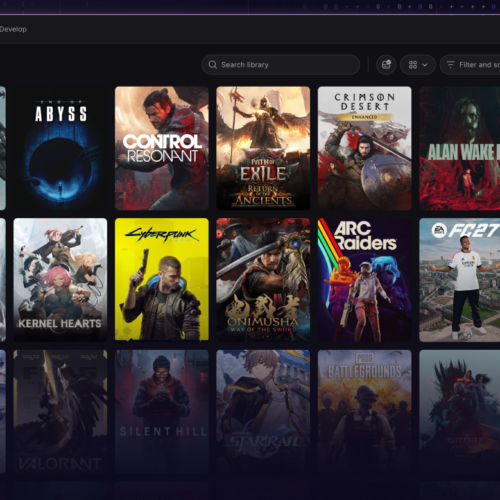
Epic says its new vibe-coded Epic Games Launcher is faster than Steam

Nearly eight years after Epic took on Steam with its own Game Store and launcher, the Fortnite maker is deploying a new tool to give it an edge over Valve: vibe coding.

In announcing the new publicly available "Preview" build of its Epic Games Launcher, Epic writes that "programming is hard. So, instead of doing that, we vibe coded a new Epic Games Launcher that’s way faster and more responsive than the current one, and has a new look." And while that might sound a little tongue-in-cheek, Epic Games Store General Manager and VP Martin Keely told PC Gamer that the team "started from scratch" and used AI as "a tool to write and review new features and new capabilities from the ground up in a different tech stack than what we had previously." The goal, Keely said, was to "look at functionality that existed [in the current Epic Games Launcher] and [say] we want to replicate that, but not the code itself."

Speaking to IGN, Keely clarified that using AI to code the new Launcher "made us more efficient and allowed a small team to rewrite the code base and be able to launch it faster across platforms, support Windows and Mac, and we're going to have a Linux version as well."

Read full article

Comments

© Epic

  •  

Legendary FPS level designer Richard "Levelord" Gray dies at 68

Prolific first-person shooter level designer Richard "Levelord" Gray died Monday at the age of 68, based on reports shared on social media by Apogee Entertainment yesterday. He had "dealt with cancer on and off for a while now," according to former colleague Joe Siegler.

After studying computer engineering in the '80s and tinkering on some early games in COBOL, Gray broke into the industry at the age of 35 in 1994 with the launch of GrayDoom, a set of four maps for the then-new Doom that were widely shared on CompuServe and beyond. The work attracted the attention of Q Studios' Nick Newhard, who contracted Gray to work on level design for the late '90s cult classic Blood.

Gray was subsequently hired by 3D Realms, where he said he was given free rein in designing "half the levels" for Duke Nukem 3D. There, he was also responsible for the famous, signed "You're Not Supposed to Be Here" easter egg, which players could find only by using cheats to explore outside of the usual confines of the map.

Read full article

Comments

© Apogee Entertainment

  •  

ESA targets Anbernic emulation handhelds as "superfake" piracy enablers

For years, Chinese hardware manufacturers have carved out a market niche with an array of handheld Android gaming devices focused on retro emulation and/or more modern game-streaming capabilities. Now, though, a major game industry trade group is targeting one of those manufacturers, Anbernic, asking the US Trade Representative (USTR) to add the company to its list of "Notorious Markets" that "engage in or facilitate substantial copyright piracy or trademark counterfeiting."

TorrentFreak was among the first to notice the request from the Entertainment Software Association (ESA), which was submitted to the USTR last week. In it, the US trade group—which represents major publishers including Nintendo, Microsoft, PlayStation, Amazon, Epic, EA, Ubisoft, and more—notes that Anbernic devices "are routinely offered or shipped with removable memory cards preloaded with hundreds or thousands of unauthorized copies of copyright-protected video games published by ESA members."

While many online sellers do include an SD card full of ROMs alongside emulation hardware of all types, Anbernic itself does not appear to do the same when selling directly from its website. Regardless, the ESA argues that these ROM-laden Anbernic devices selling through "normal retail channels" help to "normalize hardware-based piracy by delivering illicit catalogues through a polished consumer product." This, the ESA says, meets the threshold for a "superfake," an ill-defined designation that applies to "high-quality counterfeit trademark goods ... on a commercial scale."

Read full article

Comments

© Anbernic

  •  

Epic Games reportedly pivoting to "AI first" game development model

Epic Games is shifting to an "AI first" development strategy for its collaboration with the Walt Disney Company, letting AI models write all the code and guide all the artwork for an upcoming shooter. That's according to a Bloomberg report, which cites unnamed people familiar with the project who commented on the significant pivot in internal development at the Unreal Engine maker.

Human developers will be tasked with managing and guiding code and art assets generated by models such as Anthropic's Claude, according to internal Epic employee messages viewed by Bloomberg. That means "no more hand-written code" and art assets "generated with full AI workflows," according to the report.

The $1.5 billion collaboration between Epic and Disney, announced in early 2024, was slated to release a Marvel- and Star Wars-themed shooter in March 2027. That project has now been delayed indefinitely amid the AI-related shakeup and understaffed, slower-than-expected development thus far, according to the report.

Read full article

Comments

© Epic / Disney

  •  

Long-lost horror gaming cult classic P.T. gets a much-needed PC port

For over a decade now, the only "official" way to play Hideo Kojima's cult classic, P.T.—the long-discontinued "playable trailer" for Kojima's canceled "Silent Hills" project—has been via one of the increasingly rare PlayStation 4s that previously downloaded a copy during its monthslong availability window. Now, though, one coder is helping to preserve the game with a porting tool that builds a playable x86 PC executable from the original PS4 files.

Coder Lorean Xavier said he was inspired to work on the "P.T. for PC" project "because P.T. deserved to keep existing somewhere other than on consoles that still have it installed." The open source porting effort rebuilds the P.T. engine in C++ and Vulkan, using the original files from the PS4 game to re-create "every level, model, texture, sound, script and cutscene," according to its GitHub listing. That means players without their own legitimate decrypted copy of the original P.T. will have to track one down in order to generate a playable PC version.

The reliance on real P.T. files makes this port more authentic than previous hobbyist efforts to re-create the look and feel of P.T. for a PC audience. And while PS4 emulators recently reached a point where they could run P.T. completely, this native port also sports extra features, like upscaling and frame-generation, a camera mode, experimental third-person and VR support, and a "museum" section where you can look at and listen to in-game assets (including "unused content").

Read full article

Comments

© Kyle Orland / PT on PC

  •  

AI coding agents generate more code, but not more software

Anyone who has even tangentially associated with computer programming knows that modern AI coding assistants and agents can be incredibly efficient at generating huge amounts of functional code. But coders making use of those tools also know better than to trust the accuracy of that code, meaning substantial effort needs to be spent reviewing any AI-generated output.

A recent study of actual coding practices across hundreds of firms finds that human code review forms a significant "bottleneck" for the overall efficiency of AI coding tools, resulting in "little evidence that firms increase software output or reduce employment" by using them. Any efficiency increased during the actual coding phase, the study authors find, is "absorbed by downstream constraints in the production process"; as "the code review process significantly increases in length, pull requests are more likely to require revisions, and reviewers leave more comments."

Cut once, measure twice

To come to these conclusions, Harvard University researchers Fiona Chen and James Stratton made use of aggregated analytics data from Jellyfish, which measures the granular output of engineering teams. That data encompasses 300 million individual "work events" (e.g., commits and pull requests) and issue management software data across more than 700,000 employees at over 700 relevant software development firms from 2021 through March of 2026.

Read full article

Comments

© Getty Images

  •  

“Software is over”: Bold AI developer takes aim at Adobe with open source clones

For a while, those hoping to avoid the difficulty and expense of dealing with Adobe's Creative Suite have been able to use several free and/or open source alternatives that replicate some or all of those capabilities. Now, one developer is using AI-powered reverse engineering to mimic the look, feel, and functionality of Adobe's well-known software with what he hopes will soon be perfect fidelity.

Artcraft got its start last year as a "controllable AI for artists" that allows for precise post-generation editing of AI-crafted images and videos. Over the weekend, though, the brand debuted its pivot to a suite of seven open source apps recreating the user interface and tools found in Adobe's Photoshop, Illustrator, Premiere, Lightroom, After Effects, InDesign, and Acrobat Pro.

In announcing those new apps on Reddit earlier this week, software developer Brandon Thomas said he used Anthropic's Claude Opus 5.5 to create "clean-room replacements" for Adobe's closed source software in Rust (with WebAssembly versions available for use in a browser). And while commenters on Hacker News and elsewhere have taken pains to point out the new software's many current shortcomings, Thomas makes the grandiose promise that the current "super early alpha" state will soon lead to something just as functional as anything Adobe has ever put out.

Read full article

Comments

© Artcraft

  •  
❌