Reading view

Google DeepMind releases DiffusionGemma, a model that runs local AI 4x faster

Another day, another AI model from Google. This time, Google DeepMind has released a new member of the Gemma 4 open model family, but it's fundamentally different from the rest of the lineup. DiffusionGemma doesn't generate outputs linearly like most AI models. Instead, it can produce an entire block of text in parallel. Google says this makes it faster and more efficient when running on local hardware like an Nvidia DGX or a humble gaming GPU.

Most AI models are designed to be autoregressive—they generate text left to right one token at a time. DiffusionGemma has more in common with image generation models, which start with static and then denoise it to create the desired content. This model takes a field of placeholder tokens running over the canvas multiple times to generate likely tokens and using those to improve estimation of others. At the end of the process, the model finalizes its token outputs in one large block—the "denoised" text canvas.

DiffusionGemma is fairly large in the realm of Google's open models. It's a Mixture of Experts (MoE) model with a total of 26 billion parameters, but only 3.8 billion are activated during inference. That means it should fit in the 18GB RAM allotment of a high-end GPU. In testing with an RTX 5090, DiffusionGemma spits out around 700 tokens per second. With a single Nvidia H100 AI accelerator, DiffusionGemma can produce 1,000+ tokens per second. That's about four times the output of the similarly sized autoregressive Gemma models.
Read full article

Comments

© Google

  •  

Google announces Gemini 3.5 Live Translate for instant voice-to-voice translation

Google has been chasing real-time translation for years, which it says has been one of its "pioneering machine learning experiments." We've seen numerous demos on stage at Google events in the past, but you needed Google phones, earbuds, or some other specific setup. Last year, Google brought real-time translation to more users in the Translate app, and now it's expanding availability more. With the release of Gemini 3.5 Live Translate, you'll have access to instant translation in more places and with lower latency than ever before.

The new AI model is part of the version 3.5 family that launched at I/O. Before today, Google had only rolled out the Flash version, but we're expecting a Pro model to drop in the coming weeks. Gemini 3.5 Live Translate is a speech-to-speech model tuned to automatically detect and translate in more than 70 languages.

Google says Gemini 3.5 Live Translate is fast enough to keep up with a normal conversation, following just a few seconds behind the speaker while also matching intonation, pacing, and pitch. In short, the voice sounds more like you than a generic robot. The demos, which are all being recorded under controlled conditions, do sound impressive. You won't have to wait long to verify the model's abilities for yourself, though.

Read full article

Comments

© Aurich Lawson

  •  

Gemini 3.5 and Antigravity come to Google NotebookLM

Google's NotebookLM was one of the company's first forays into generative AI technology, and in un-Googley fashion, it hasn't been shut down yet. In fact, NotebookLM is getting one of its biggest updates, ever, today, moving to the latest Gemini 3.5 model, support for more file types, and streamlined web source integration. Google also says NotebookLM will be able to do more with all those queries thanks to embedded support for Antigravity.

Gemini 3.5 Flash debuted at Google I/O this year, promising much faster and more efficient processing. Google has claimed that companies worried about token costs can save big by moving their projects to the new Flash model while also getting outputs that are of similar or better quality. Those improvements are now filtering down to other Google products. NotebookLM, which launched in 2023 at the very beginning of the AI boom, lets you analyze specific sources like documents and webpages with Google's latest AI models.

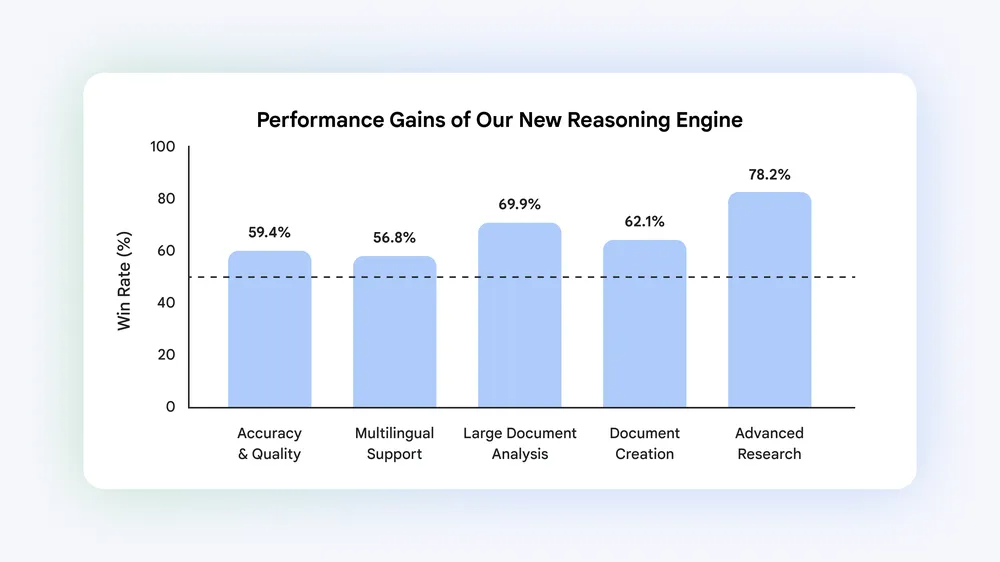
NotebookLM evaluation graph The upgraded NotebookLM beats the old version in all of Google's "core evaluation dimensions." Credit: Google

Google conducted side-by-side evaluations of NotebookLM on the old Gemini 3.1 branch and with the updated 3.5. The company is being somewhat vague about the nature of the tests, breaking things up into "top five core evaluation dimensions," which are Accuracy and Quality, Multilingual Support, Large Document Analysis, Document Creation, and Advanced Research. In these tests, Google says NotebookLM averaged a 65 percent win rate versus the older model.

Read full article

Comments

© Google

  •  

The Fitbit Air is a good wearable weighed down by a chatty AI "coach"

Smartwatches can track your health stats, but they also do a lot of other things you might not always want or need. The $100 Fitbit Air tracker ditches the screens that have become common on people's wrists, leaving behind a tiny puck of health sensors you can often forget you're wearing. You will not, however, forget that Google's new health platform is built around AI.

The Air has no speaker, and there's only one LED on the side to indicate battery level. You can double-tap the tracker to check the level, and that's about the end of on-device features. The vibration motor is only for alarms—it can't sync with notifications on your phone. That makes sense, given there is no screen to tell you what that buzz was all about.

Fitbit Air side view The Fitbit Air doesn't have a display or buttons—just a small LED on the side for battery status. Credit: Ryan Whitwam

The stock Performance Band is simple, consisting of a smooth polyester yarn with small velcro pads and a metal loop. It's durable but does seem to absorb a bit of moisture. For swimming or heavy workouts, you'll probably want the silicone active band. This one hides the Air puck a bit more effectively, and it looks good in a sporty way.

Read full article

Comments

© Ryan Whitwam

  •  
❌