Reading view

Pentagon boasts of using AI to write reports mandated by Congress

The US Department of Defense has a lot of congressionally mandated homework to do every year involving hundreds of required reports on various national security topics. But Pentagon officials have been proudly describing a new shortcut—using generative AI tools to write such reports for Congress.

Pentagon Chief Technology Officer Emil Michael highlighted AI-generated reports to Congress as a key example of how the Department of Defense—stylized as the Department of War under the Trump administration—has adopted generative AI during an event hosted by the Hudson Institute think tank in Washington, DC, on June 12. The Pentagon has made AI tools, starting with Google Cloud’s Gemini for Government, widely available to members of all six military branches through the department’s bespoke GenAI.mil platform since December 2025.

“I have to report to Congress every year on this thing,” Michael said. “Let me load all the papers onto it and have it draft me a congressional report that would otherwise take 200 hours of staffing time and do it in five hours.”


Read full article

Comments

© SAUL LOEB / AFP via Getty Images

  •  

Android 17 starts hitting Pixel phones and watches today

Android 17 has been in testing since early this year, with the final beta hitting devices just a couple of weeks ago. Insofar as a mature operating system like Android still has big days, this is one of them. The official Android 17 build is starting its rollout on Pixel phones, adding a small set of new features and laying the groundwork for the future. This release also coincides with a Pixel Drop and a new version of Wear OS (based on Android 17) on Pixel Watches.

Google no longer uses an unmodified version of Android on its phones—the Pixel build includes numerous features that are distinct from Android 17 itself. Other device makers will include versions of some of these features when they eventually update their phones, but for now, Google's Pixel phones are the only way to experience Android 17.

The multitasking Bubbles system in Android 17 expands on a similar (but underutilized) messaging feature. In Android 17 on Pixels, you can long-press on any app icon to open that app as a floating window. When minimized, these bubbles stay on top of other apps. On foldable phones, the bubbles dock into a "bubble bar" for easy multitasking.

Read full article

Comments

© Ryan Whitwam

  •  

When it comes to total water use, AI data centers are a drop in the bucket

If you hang out in any even vaguely AI-skeptical parts of the Internet, you've probably stumbled on plenty of memes and posts premised on data centers' insatiable thirst for water to power evaporative cooling. But a new report from Amazon highlights just how little water all these AI data centers are using in aggregate, on a relative basis, even as individual data centers can strain local water supplies.

In a Thursday blog post, Amazon claims its data centers withdrew "about 2.5 billion gallons" globally in 2025. That number sounds incredibly large at first glance, but it looks downright puny compared to the 117 trillion gallons of water withdrawn in the US alone in 2015. It's also useful to compare Amazon's number to stats from more water-intensive areas, from the 3.3 trillion gallons used annually on US lawns and landscaping to the 1.3 trillion gallons a year used in California almond orchards to the 531 billion gallons a year used just for US golf courses.

Amazon is just one company, of course, and a relative latecomer to reporting its data center water usage numbers. Google data centers withdrew about more than 6.1 billion gallons of water in 2024, on top of about 2.75 billion gallons from Microsoft and about 1.4 billion gallons from Meta in the same year.

Read full article

Comments

© Getty Images

  •  

Google sues Chinese cybercrime network that used Gemini to automate scams

Google loves telling us all the ways people are using its generative AI products to build new things, grow businesses, and save the world. Supposedly. Of course, people are also using AI for crime. Google has announced a new legal salvo aimed at a Chinese group called Outsider Enterprise, which is allegedly responsible for a massive AI-powered scam campaign. Google says it's working with law enforcement and mobile carriers to fight back.

According to Google's legal filing, Outsider Enterprise operates through Telegram. The group offers phishing-as-a-service to individuals who may not be technically savvy enough to set up fraudulent websites and text campaigns on their own. In its Telegram channels, Outsider Enterprise reportedly provided instructions on how to use Google's Gemini AI to create websites that imitate those of Google, YouTube, and government agencies such as New York’s E-ZPass. The group offered nearly 300 scam templates.

Google says that scams enabled by Outsider Enterprise resulted in more than 2.5 million text messages being sent to Android users. About 55,000 of those messages happened in a two-week period last month. In all, Google has tracked 9,000 fake websites and 1 million URLs connected to the scam network.

Read full article

Comments

© Aurich Lawson

  •  

Google DeepMind releases DiffusionGemma, a model that runs local AI 4x faster

Another day, another AI model from Google. This time, Google DeepMind has released a new member of the Gemma 4 open model family, but it's fundamentally different from the rest of the lineup. DiffusionGemma doesn't generate outputs linearly like most AI models. Instead, it can produce an entire block of text in parallel. Google says this makes it faster and more efficient when running on local hardware like an Nvidia DGX or a humble gaming GPU.

Most AI models are designed to be autoregressive—they generate text left to right one token at a time. DiffusionGemma has more in common with image generation models, which start with static and then denoise it to create the desired content. This model takes a field of placeholder tokens running over the canvas multiple times to generate likely tokens and using those to improve estimation of others. At the end of the process, the model finalizes its token outputs in one large block—the "denoised" text canvas.

DiffusionGemma is fairly large in the realm of Google's open models. It's a Mixture of Experts (MoE) model with a total of 26 billion parameters, but only 3.8 billion are activated during inference. That means it should fit in the 18GB RAM allotment of a high-end GPU. In testing with an RTX 5090, DiffusionGemma spits out around 700 tokens per second. With a single Nvidia H100 AI accelerator, DiffusionGemma can produce 1,000+ tokens per second. That's about four times the output of the similarly sized autoregressive Gemma models.

Read full article

Comments

© Google

  •  

Nobody needs AI to search the Internet, court says in ruling against Google

Potentially impacting all AI search engines and chatbots known to poorly paraphrase source links, a German court has ruled that Google is liable for false statements in AI Overviews.

The preliminary ruling came in a case flagged by The Decoder, where two publishers found that Google's AI Overviews incorrectly linked them to scams and other sketchy business practices. After smearing publishers by making affirmative statements like "Yes, [it] is known for dubious business practices and is often perceived as a scam," Google failed to correct the misleading output, even after the publishers sent a cease-and-desist letter earlier this year.

Google tried the usual arguments to shield itself from liability for false statements in AI Overviews, such as arguing that most users understand that AI outputs aren't always accurate and must be verified.

Read full article

Comments

© SOPA Images / Contributor | LightRocket

  •  

Google announces Gemini 3.5 Live Translate for instant voice-to-voice translation

Google has been chasing real-time translation for years, which it says has been one of its "pioneering machine learning experiments." We've seen numerous demos on stage at Google events in the past, but you needed Google phones, earbuds, or some other specific setup. Last year, Google brought real-time translation to more users in the Translate app, and now it's expanding availability more. With the release of Gemini 3.5 Live Translate, you'll have access to instant translation in more places and with lower latency than ever before.

The new AI model is part of the version 3.5 family that launched at I/O. Before today, Google had only rolled out the Flash version, but we're expecting a Pro model to drop in the coming weeks. Gemini 3.5 Live Translate is a speech-to-speech model tuned to automatically detect and translate in more than 70 languages.

Google says Gemini 3.5 Live Translate is fast enough to keep up with a normal conversation, following just a few seconds behind the speaker while also matching intonation, pacing, and pitch. In short, the voice sounds more like you than a generic robot. The demos, which are all being recorded under controlled conditions, do sound impressive. You won't have to wait long to verify the model's abilities for yourself, though.

Read full article

Comments

© Aurich Lawson

  •  

Gemini 3.5 and Antigravity come to Google NotebookLM

Google's NotebookLM was one of the company's first forays into generative AI technology, and in un-Googley fashion, it hasn't been shut down yet. In fact, NotebookLM is getting one of its biggest updates, ever, today, moving to the latest Gemini 3.5 model, support for more file types, and streamlined web source integration. Google also says NotebookLM will be able to do more with all those queries thanks to embedded support for Antigravity.

Gemini 3.5 Flash debuted at Google I/O this year, promising much faster and more efficient processing. Google has claimed that companies worried about token costs can save big by moving their projects to the new Flash model while also getting outputs that are of similar or better quality. Those improvements are now filtering down to other Google products. NotebookLM, which launched in 2023 at the very beginning of the AI boom, lets you analyze specific sources like documents and webpages with Google's latest AI models.

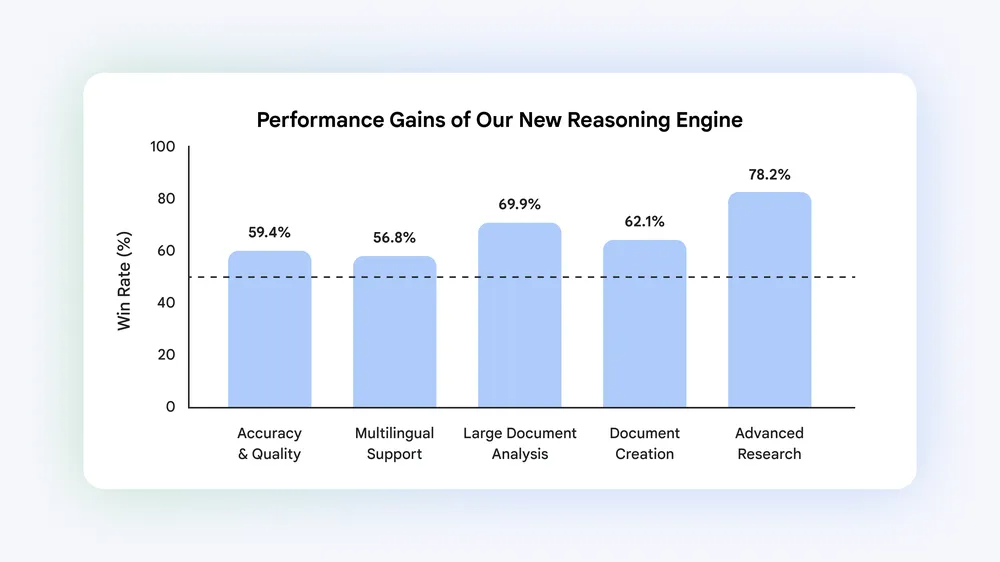
NotebookLM evaluation graph The upgraded NotebookLM beats the old version in all of Google's "core evaluation dimensions." Credit: Google

Google conducted side-by-side evaluations of NotebookLM on the old Gemini 3.1 branch and with the updated 3.5. The company is being somewhat vague about the nature of the tests, breaking things up into "top five core evaluation dimensions," which are Accuracy and Quality, Multilingual Support, Large Document Analysis, Document Creation, and Advanced Research. In these tests, Google says NotebookLM averaged a 65 percent win rate versus the older model.

Read full article

Comments

© Google

  •  

The Fitbit Air is a good wearable weighed down by a chatty AI "coach"

Smartwatches can track your health stats, but they also do a lot of other things you might not always want or need. The $100 Fitbit Air tracker ditches the screens that have become common on people's wrists, leaving behind a tiny puck of health sensors you can often forget you're wearing. You will not, however, forget that Google's new health platform is built around AI.

The Air has no speaker, and there's only one LED on the side to indicate battery level. You can double-tap the tracker to check the level, and that's about the end of on-device features. The vibration motor is only for alarms—it can't sync with notifications on your phone. That makes sense, given there is no screen to tell you what that buzz was all about.

Fitbit Air side view The Fitbit Air doesn't have a display or buttons—just a small LED on the side for battery status. Credit: Ryan Whitwam

The stock Performance Band is simple, consisting of a smooth polyester yarn with small velcro pads and a metal loop. It's durable but does seem to absorb a bit of moisture. For swimming or heavy workouts, you'll probably want the silicone active band. This one hides the Air puck a bit more effectively, and it looks good in a sporty way.

Read full article

Comments

© Ryan Whitwam

  •  

These LLMs are the best at resisting Russian propaganda

As more people rely on large language models to provide pat answers to complex questions, state governments are understandably worried about those LLMs spouting what they see as dangerous propaganda promoted by foreign adversaries. To help combat this problem, the government-sponsored Estonian Language Institute (ELI) has released a new "Propaganda Resistance" benchmark ranking dozens of LLMs on their ability to avoid "tak[ing] positions on topics that the Russian Federation uses in its strategic narratives."

As a former member of the Soviet Union that has been independent for just a few decades, many Estonians are particularly alert to what they see as false narratives being promoted from their large and often belligerent neighbor to the east. Alongside volunteer-run Estonian defense collective Propastop, the ELI identified 14 broad categories in which it sees Russian influence operations trying to sway public discussion. These range from narratives on the current status of Crimea and justifications for the war in Ukraine to the history of NATO and justification for Russia's annexation of Baltic states during World War II.

For each category of propaganda, the researchers developed separate questions phrased to be neutral, biased with "false assumptions" based on Russian propaganda, or to maliciously attempt to elicit explicit misinformation from the LLM. Questions were provided to the models in English, Estonian, and Russian, and judged by a separate AI model (calibrated to align with Propastop experts) based on the models' ability to "push back on propaganda narratives, without external help" from web search or other external tools.

Read full article

Comments

© Getty Images

  •  
❌