Reading view

How Anthropic may have talked itself into an AI export ban

Anthropic has warned about the dangers of advanced AI far more often than rival OpenAI this year, according to FT analysis, as critics accuse the company of helping to trigger a US ban on foreign access to its newest models.

Five in every 1,000 words used by Anthropic in 2026 related to risk, regulation, or restrictions, according to FT research that analyzed official statements, social media posts, and articles written by the company or its chief, Dario Amodei. The equivalent figure for OpenAI and Sam Altman was eight times lower, at 0.6 words per 1,000.

The comparison has become politically charged after Washington last week barred foreign nationals from using Anthropic’s latest models, Mythos and Fable. Some technologists have blamed the decision on the $965 billion AI group’s repeated warnings about AI’s risk to society—particularly in relation to Mythos.


Read full article

Comments

© Financial Times

  •  

Bernie Sanders unveils $7 trillion plan to give Americans control of AI industry

Bernie Sanders has unveiled an aggressive plan to transfer trillions from leading AI firms to the public, and, to the likely horror of AI firms, it goes even further than expected to give Americans more control over the AI industry.

Sanders shared a summary of his legislation with AP News. If passed, the law would create a sovereign wealth fund “financed through a one-time 50 percent tax on the stock of the largest AI companies,” AP News reported. Any AI firm that does $200 million in annual AI sales would be subject to the tax, as would any new firm once it reaches that revenue level.

In total, Sanders estimated the fund could be worth $7 trillion, generating “hundreds of billions of dollars annually in direct payments to Americans and programs such as health care, education and housing,” AP News reported. Each American would likely receive more than $1,000 annually in 5 percent annual dividends, Sanders estimated.

Read full article

Comments

© Nuthawut Somsuk | iStock / Getty Images Plus

  •  

Anthropic "pauses" token-based billing for its Claude Agent SDK

Last month, Anthropic announced a billing change that would have substantially increased costs for heavy users of its automation-focused Claude Agent SDK, including many third-party apps. On Monday, though, Anthropic abruptly announced it had paused those pricing changes just as they were set to take effect, allowing Agent SDK users to continue drawing from the more generous usage limits in their existing Claude subscriptions.

The plan, as announced on May 13, would have treated usage of the Claude Agent SDK (including via third-party apps and the programmatic "claude -p" command) separately from "standard" Claude usage via the chat interface or the official Claude CLI. At the time, Anthropic said that, as of June 15, that kind of outside SDK usage would be billed at Anthropic's prevailing API rates, with subscribers receiving a simple monthly usage credit equal to their subscription price.

That would have been a major change from the current setup, where Agent SDK use is limited only by the standard weekly caps applied to a user's current Claude subscription tier. Those generous limits allow power users to squeeze a lot more usage out of those paid subscriptions than they would get by paying the same price for API fees. One analysis suggests that Claude Opus users start saving money from their subscription after just two to three messages per day, and that their subscription could be worth many multiples of its monthly cost in API usage.

Read full article

Comments

© Anthropic

  •  

Leaked financial docs show OpenAI is losing billions of dollars a year

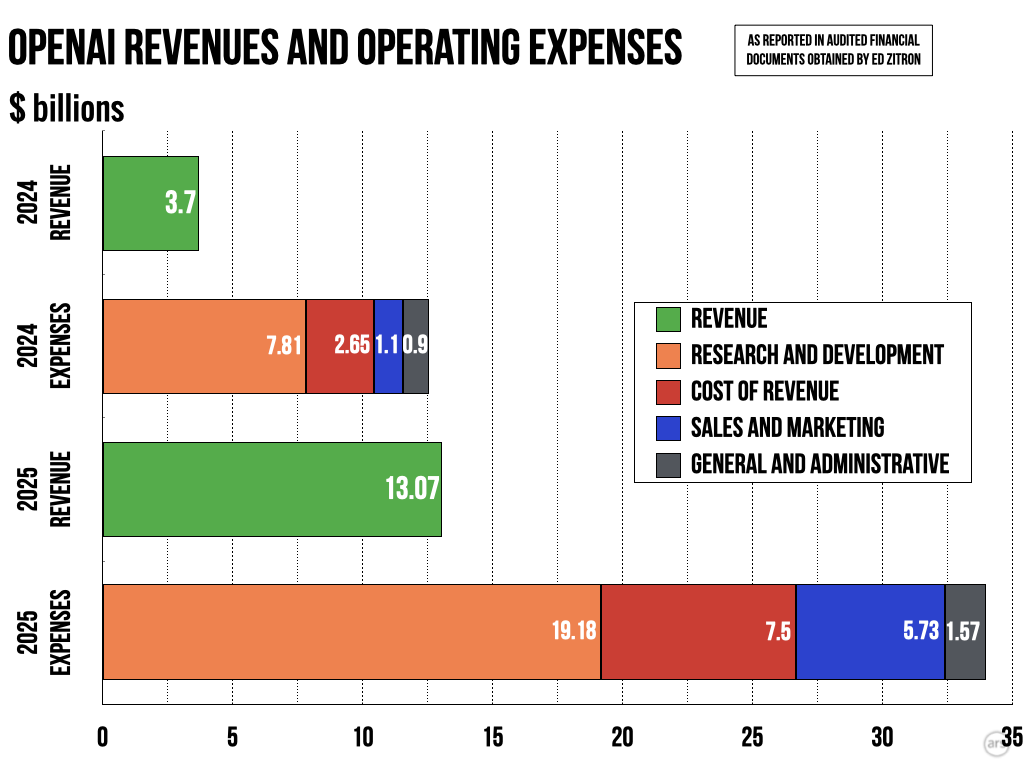
As OpenAI files SEC paperwork ahead of an expected initial public stock offering, newly leaked financial documents show a company with quickly growing revenues that are currently being overwhelmed by even larger expenses.

The audited financial statements, obtained by independent journalist Ed Zitron, show OpenAI's reported revenue growing from $3.7 billion in 2024 to $13.07 billion in 2025. The Financial Times, which reviewed the same documents, writes that the company's monthly revenues had grown to nearly $2 billion by the end of 2025, suggesting that its ongoing revenue rates continued to grow throughout the year.

R&D expenses alone still easily outpace OpenAI's quickly growing revenues. Credit: Ars Technica

But the company's fast-growing revenues are still dwarfed by its even more significant expenses. OpenAI's total revenues in both of the last two years were outpaced by research and development alone, which grew from a $7.81 billion line item in 2024 to a massive $19.18 billion cost in 2025. Those numbers seem to reflect the significant costs OpenAI incurred in training new models and include $10.59 billion in R&D costs paid to Microsoft alone in 2025.

Read full article

Comments

© Getty Images

  •  

Anthropic shuts down Fable, Mythos models following Trump admin directive

Anthropic completely shut off access to its Mythos 5 and Fable 5 models Friday night, just days after they were launched.

The move comes after Anthropic's receipt of a US Commerce Department directive Friday evening, subjecting the new models to export controls restricting their use anywhere outside the United States. In a message posted Friday night, Anthropic said the only way for it to ensure compliance with that government order in the immediate term "is that we must abruptly disable Fable 5 and Mythos 5 for all our customers." Access to other Anthropic models is not affected.

An Axios report cited an administration official saying that the administration is concerned by reports of a jailbreak that reportedly gets around broad classifier-based safeguards meant to block Fable 5 prompts regarding cybersecurity, chemistry, and biology. The administration reportedly requested a pause in the release of these models to gain time for the "national security apparatus" to be "hardened" against this kind of threat. That hardening could be complete "in the next few weeks," Axios' source suggested.

Read full article

Comments

© Anthropic

  •  

Anthropic says these topics are too dangerous to let its Fable 5 model talk about

Anthropic Tuesday publicly released Claude Fable 5, its first "Mythos-class" model that it says surpasses its previous frontier Opus models in overall capabilities. But the model's launch today comes with safeguards designed to prevent it from answering queries on topics like cybersecurity, biology, and chemistry, where the company has publicly worried about its potential impact to "uplift" malicious actors.

Anthropic says Fable 5 operates on the "same underlying model" as Mythos 5, which is coming out of its monthslong "Mythos Preview" period today, but only for "a small group of cyberdefenders" judged trustworthy through the existing Project Glasswing. Unlike Mythos 5, though, the publicly accessible Fable 5 is designed to funnel queries on certain sensitive topics to the earlier Claude Opus 4.8 model and to warn the user when this is happening.

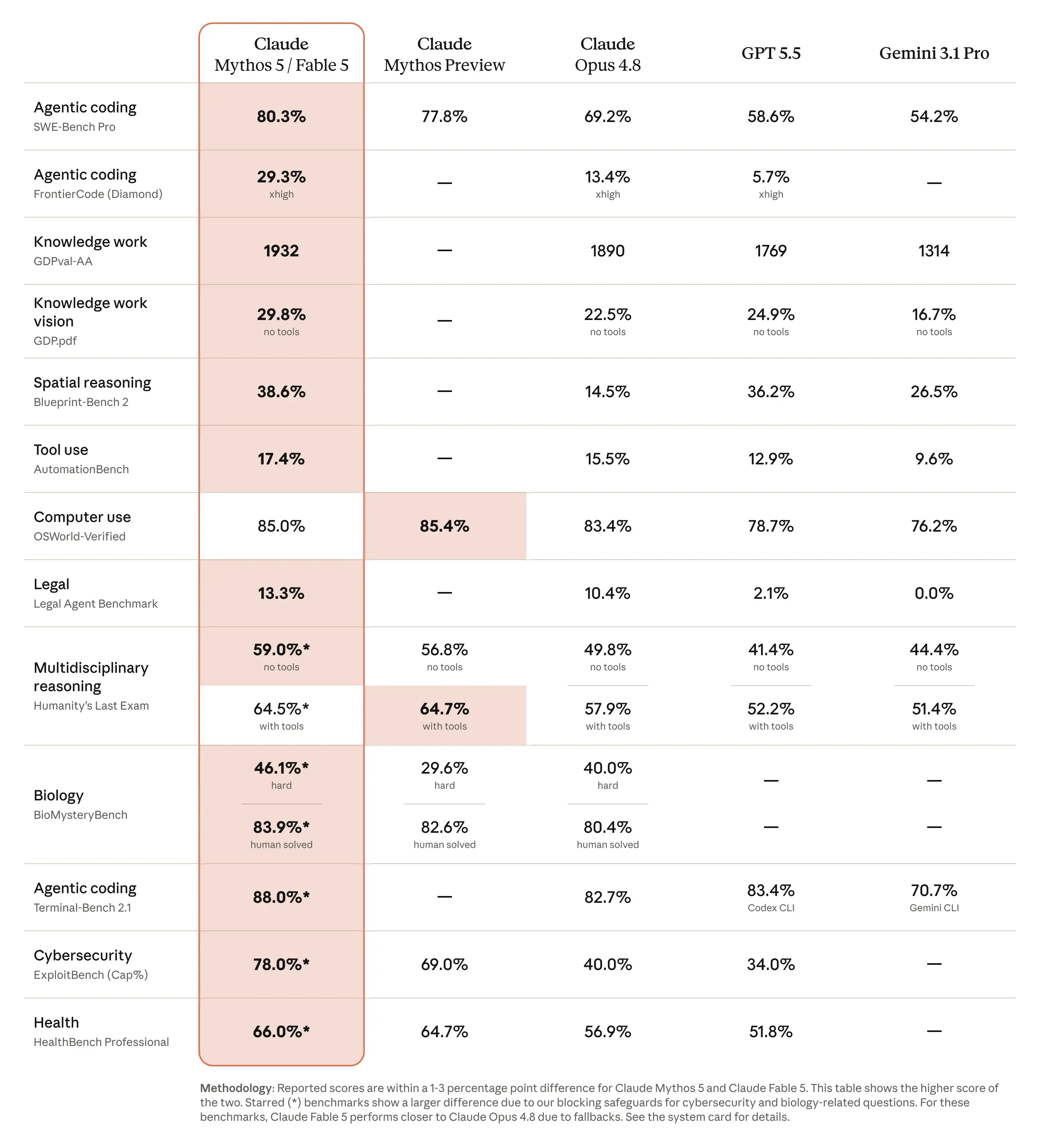
Among the many claimed benchmark improvements for Fable 5, the one related to cybersecurity was a particularly large jump. Credit: Anthropic

Anthropic said it has tuned these safeguards to be "stricter than ideal," meaning the system may occasionally refuse "harmless requests" in a way that it acknowledges may be frustrating for regular users. But Anthropic says such false positives come up in less than five percent of all sessions in testing, and were worth it to avoid situations where Mythos could give malicious actors assistance in "causing serious harm that they couldn’t have received from other sources."

Read full article

Comments

© Getty Images

  •  

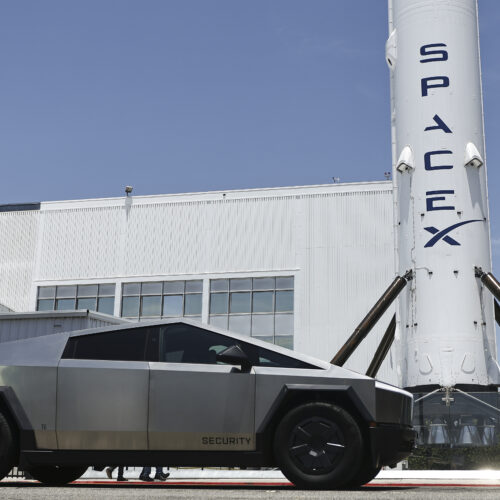
S&P 500 rejects SpaceX, also blocking entry for OpenAI and Anthropic

SpaceX has requested unusually swift entry into several leading stock market indexes as a condition of its historic stock market debut. But the S&P 500 stock market index representing many of the largest profitable US companies has surprised market analysts by refusing to bend the rules for Elon Musk’s space and AI company.

The June 4 decision by S&P Dow Jones Indices—the company that creates and manages stock market indexes such as the S&P 500—means that SpaceX will not gain accelerated access to potentially billions more dollars through passive investment funds that automatically purchase shares of S&P 500 companies. Modifying the rules in response to SpaceX's request could have also allowed leading AI companies such as OpenAI and Anthropic to gain entry not long after their own expected initial public offerings (IPOs). That possibility has now been shuttered.

The news will likely come as a relief to people concerned about passive investor money and people’s retirement savings plans having greater exposure to the market risks associated with SpaceX’s big bet on AI and speculative orbital data center plans. AI companies are generally facing more challenges in funding and building expensive AI data centers, even as they shift more of the subsidized costs of running AI services onto shocked customers through usage-based pricing.

Read full article

Comments

© Michael Yanow/NurPhoto via Getty Images

  •  

These LLMs are the best at resisting Russian propaganda

As more people rely on large language models to provide pat answers to complex questions, state governments are understandably worried about those LLMs spouting what they see as dangerous propaganda promoted by foreign adversaries. To help combat this problem, the government-sponsored Estonian Language Institute (ELI) has released a new "Propaganda Resistance" benchmark ranking dozens of LLMs on their ability to avoid "tak[ing] positions on topics that the Russian Federation uses in its strategic narratives."

As a former member of the Soviet Union that has been independent for just a few decades, many Estonians are particularly alert to what they see as false narratives being promoted from their large and often belligerent neighbor to the east. Alongside volunteer-run Estonian defense collective Propastop, the ELI identified 14 broad categories in which it sees Russian influence operations trying to sway public discussion. These range from narratives on the current status of Crimea and justifications for the war in Ukraine to the history of NATO and justification for Russia's annexation of Baltic states during World War II.

For each category of propaganda, the researchers developed separate questions phrased to be neutral, biased with "false assumptions" based on Russian propaganda, or to maliciously attempt to elicit explicit misinformation from the LLM. Questions were provided to the models in English, Estonian, and Russian, and judged by a separate AI model (calibrated to align with Propastop experts) based on the models' ability to "push back on propaganda narratives, without external help" from web search or other external tools.

Read full article

Comments

© Getty Images

  •  
❌