Reading view

How Anthropic may have talked itself into an AI export ban

Anthropic has warned about the dangers of advanced AI far more often than rival OpenAI this year, according to FT analysis, as critics accuse the company of helping to trigger a US ban on foreign access to its newest models.

Five in every 1,000 words used by Anthropic in 2026 related to risk, regulation, or restrictions, according to FT research that analyzed official statements, social media posts, and articles written by the company or its chief, Dario Amodei. The equivalent figure for OpenAI and Sam Altman was eight times lower, at 0.6 words per 1,000.

The comparison has become politically charged after Washington last week barred foreign nationals from using Anthropic’s latest models, Mythos and Fable. Some technologists have blamed the decision on the $965 billion AI group’s repeated warnings about AI’s risk to society—particularly in relation to Mythos.


Read full article

Comments

© Financial Times

  •  

"Dangerous" AI models are coming no matter what

Late last week, Anthropic took its new Claude Fable 5 and Mythos 5 AI models offline following a United States government export-control directive barring “any foreign national” from using the services. The company has been in talks with the White House since Friday but has yet to secure an agreement that would allow it to reinstate the offerings.

Since Mythos debuted in April, Anthropic has claimed—and warned—that the model has advanced capabilities for not only finding software vulnerabilities to help defenders patch them, but also figuring out ways to exploit them that could be used by bad actors. Anthropic itself noted this double-edged sword in its launch of Mythos 5 and Claude Fable 5. “A great deal of advanced usage of AI models is dual use: the same queries that are beneficial in the hands of cybersecurity professionals and biology researchers could be dangerous if available to malicious actors,” the company wrote in a blog post last week.

With this in mind, the company initially released a version called Mythos Preview to a select consortium as part of a working group known as Project Glasswing. Mythos 5 was also privately released to this group last week, while Claude Fable 5, which is a Mythos-grade model, was released to the general public with specific blocks on its ability to give responses to questions about biology and cybersecurity.

Read full article

Comments

© Samuel Axon

  •  

Anthropic says these topics are too dangerous to let its Fable 5 model talk about

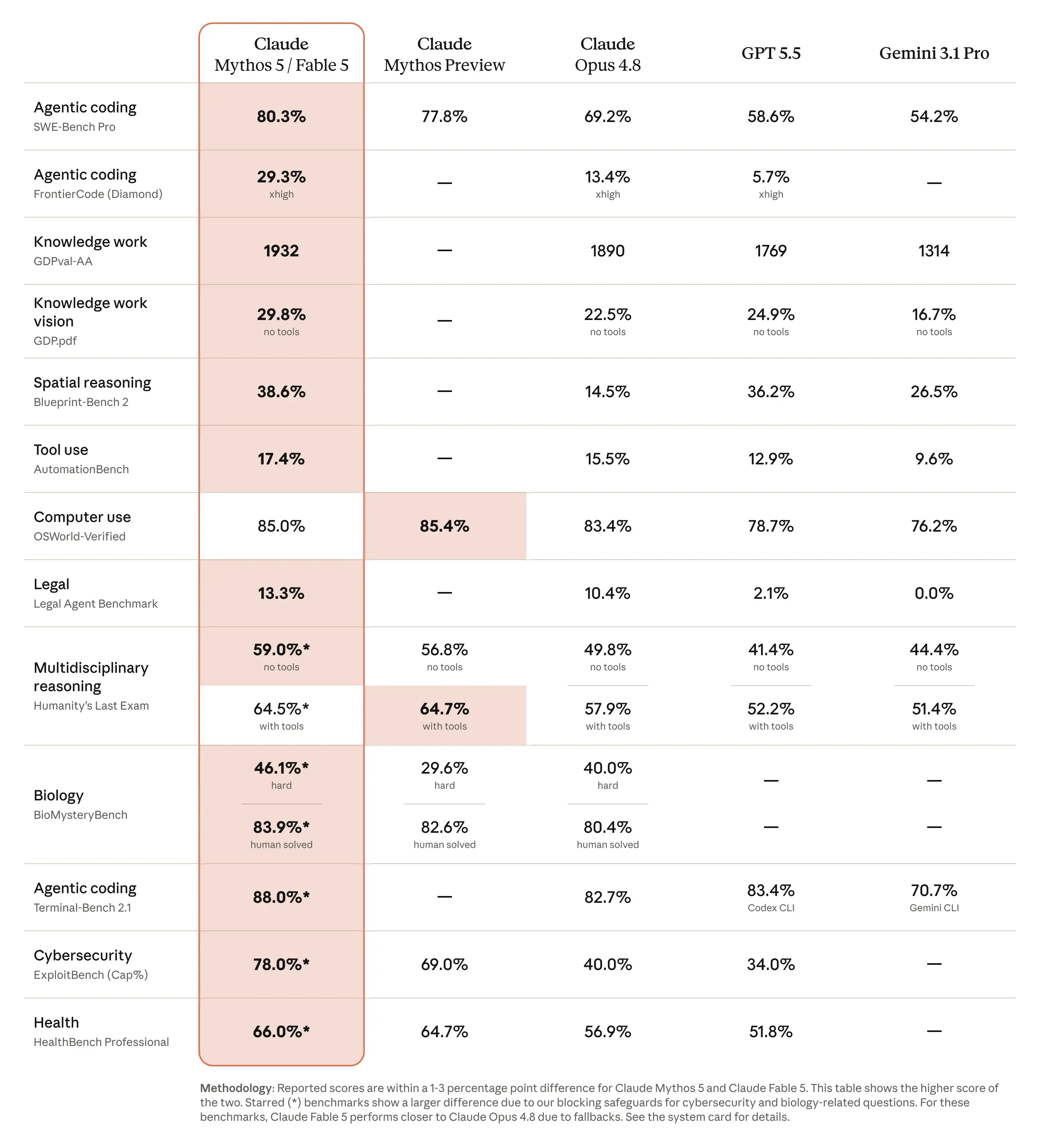
Anthropic Tuesday publicly released Claude Fable 5, its first "Mythos-class" model that it says surpasses its previous frontier Opus models in overall capabilities. But the model's launch today comes with safeguards designed to prevent it from answering queries on topics like cybersecurity, biology, and chemistry, where the company has publicly worried about its potential impact to "uplift" malicious actors.

Anthropic says Fable 5 operates on the "same underlying model" as Mythos 5, which is coming out of its monthslong "Mythos Preview" period today, but only for "a small group of cyberdefenders" judged trustworthy through the existing Project Glasswing. Unlike Mythos 5, though, the publicly accessible Fable 5 is designed to funnel queries on certain sensitive topics to the earlier Claude Opus 4.8 model and to warn the user when this is happening.

Among the many claimed benchmark improvements for Fable 5, the one related to cybersecurity was a particularly large jump. Credit: Anthropic

Anthropic said it has tuned these safeguards to be "stricter than ideal," meaning the system may occasionally refuse "harmless requests" in a way that it acknowledges may be frustrating for regular users. But Anthropic says such false positives come up in less than five percent of all sessions in testing, and were worth it to avoid situations where Mythos could give malicious actors assistance in "causing serious harm that they couldn’t have received from other sources."

Read full article

Comments

© Getty Images

  •  
❌