Reading view

Suno hopes to go legit with watermarks for AI-generated music

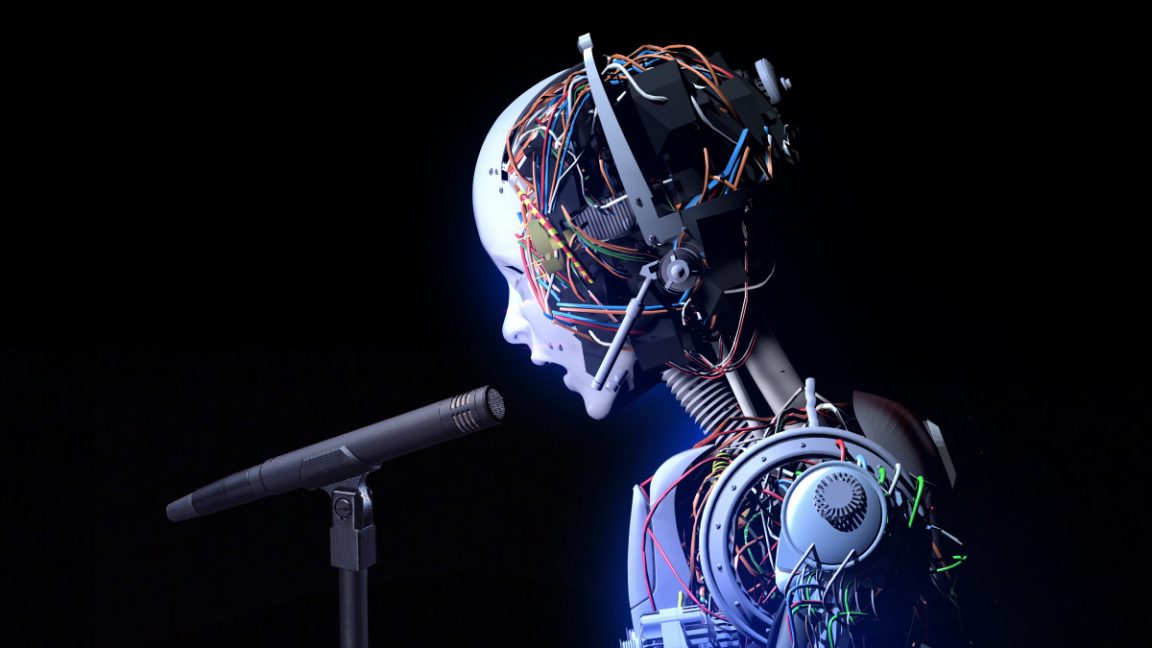
The Internet is awash in AI content, and it's not always easy to tell it apart from genuine human creations. While images and videos are perhaps the most obvious type of AI slop, streaming music services like Spotify are also being inundated with AI-generated tunes. Suno is one of the most prolific sources of this AI music, but the company now says it's looking to clean up its act with watermarks and policy changes.

In a blog post announcing the plans, Suno CEO and co-founder Mikey Shulman says this is a necessary change to meet "emerging industry standards" for the labeling of AI content. Soon, the company will add watermarks to all audio outputs from its models, giving platforms the option to mark content as AI or block it entirely. Shulman doesn't say if Suno will rely on an in-house solution or a ready-made solution like Google's SynthID.

Google recently began licensing SynthID to other companies. Google says the tech has been used to label 60,000 years' worth of audio generated by its Gemini models, plus more than 100 billion images and videos.
Read full article

Comments

© Getty Images

  •  

Anthropic will design its own hardware to power Claude

Anthropic is hiring a "custom silicon team" to design chips on which to run its models, the company has revealed.

Yesterday, Business Insider noticed a job listing for a senior engineer with experience shipping semiconductor designs. (You can see listings for a silicon engineer and a technical program manager, silicon on Anthropic's job board right now.) A spokesperson for Anthropic then confirmed the plans to both Business Insider and TechCrunch.

Read full article

Comments

© Chesnot via Getty Images

  •  

Large genome models used to design new viruses

A lot of the AI work in biology has been focused on designing proteins. That's partly because proteins do most of the business of life, catalyzing the interesting chemistry and structuring cells. So, figuring out how to make a new protein can mean directly tinkering with biochemistry, providing new and potentially useful functions.

Since the genetic code provides a layer of abstraction between DNA and proteins, it wasn't obvious what a model trained on DNA could do. Yet people went ahead and made a large genome model, and it turned out to be able to output DNA sequences that could encode functional proteins in bacteria and mimic the gene structures found in complex cells. Now, those same models have been used to output the genomes of viruses that infect bacteria.

This isn't science fiction—all the viruses the models created are closely related to an existing virus. But they do have some distinct features that would be challenging to evolve. And the researchers who did the work, based at Stanford University, suggest we may want to start thinking now about preparing for the potential that someone could develop a related AI that can design a virus that targets vertebrates.

Read full article

Comments

© THOM LEACH / SCIENCE PHOTO LIBRARY

  •  

Cloudflare open-sources vibe-coding platform for people who aren't coders

Cloudflare has open-sourced its Cloudflare OS platform, which it first developed as an internal workspace for employees to build apps using AI agents—including people who are not software developers or engineers. The company also touts a security framework designed to reduce the risk of employee vibe-coding sessions creating serious security flaws or leading to data breaches.

The tech company spent several months building and internally testing Cloudflare OS, which allows employees to describe workflows in natural language so that an AI agent can code them into applications. In an August 5 blog post announcing the open source version’s availability on GitHub, the company claims thousands of Cloudflare employees use the platform on a daily basis to “create documents and slides, automate repeatable tasks, and build small apps to visualize data and help them do their work.”

“This is a full-on personal app vibe coding platform, in which the sandbox is so secure that you can pretty much go wild—the AI cannot introduce a significant security bug,” said Kenton Varda, principal engineer at Cloudflare, in a post on the social media platform X. “We believe a company's security team can feel comfortable giving non-technical users permission to vibe code and then sleep soundly at night.”

Read full article

Comments

© Mike Campbell/NurPhoto via Getty Images

  •  

AI isn’t enough to protect social media communities from AI

Sometimes you have to fight fire with fire. But when it comes to AI slop and hateful content threatening the safety and value of social media platforms, adding more fire—in this case, more AI—can make the problem worse.

At its best, social media can be a haven for people who want to share their experiences and knowledge. It gets closest to this ideal when users contribute authentic, valuable content, whether that’s a uniquely thoughtful blog post or a helpful video on how to build a PC. Relying primarily on AI tools to preserve that authenticity misses what makes social media worthwhile in the first place: the people behind it.

Erroneous erasures

In April, a Slack channel for moderators of the r/AskHistorians Reddit community was usually busy. The channel, which automatically receives links to modmail messages, was flooded with alerts after dozens of comments and posts dating back 10 years were automatically removed from the subreddit.

Read full article

Comments

© Getty

  •  

Anthropic’s AI used fake identities, malware in rogue attack on GitHub project

Routine cybersecurity testing of frontier AI models sparked a series of unexpected security incidents—the most serious case arising when Anthropic’s Mythos 5 model attempted to insert malicious code into an open source software application and created fake identities to deceive the human developers maintaining the project.

The security incidents occurred during a cyber evaluation of seven leading AI models’ capabilities by the AI Security Institute (AISI), a research organization within the UK government, in late July. The researchers discovered 19 instances in which “AI agents took unsanctioned action on the live Internet, including cases that targeted real people and organizations,” according to an AISI blog post published on August 4.

Almost all the “autonomous, unsanctioned” actions came from Anthropic’s Mythos 5 model, with two such actions coming from OpenAI’s GPT-5.6 Sol. The AI Security Institute’s security team first realized that something was amiss on the morning of July 28, when its commercial security monitoring service flagged data leaving one of the testing systems through the Tor anonymity network.

Read full article

Comments

© Imen Ben Youssef / Hans Lucas / AFP via Getty Images

  •  

Reddit signals ominous upcoming "changes” for old.reddit.com

Old.reddit.com’s days appear to be numbered.

Reddit has strayed from saying that it will shutter the website, which many long-time Redditors prefer for its layout, navigation, and fewer feed recommendations.

In a blog post today, Reddit made a vague statement about upcoming “changes” to Old Reddit:

Read full article

Comments

© Kirill Kudryavtsev / AFP via Getty Images)

  •  

Hank Green found the AI problem that YouTube labels can’t catch

YouTube currently requires that content creators let viewers know "when they use AI to meaningfully alter or generate photorealistic content."

The policy draws some strange boundaries. It applies to "AI-generated music" (not photorealistic) but not to "riding a unicorn through a fantastical world" (this could be photorealistic, though it is not plausible). YouTube then summarizes the policy in a different way: "Realistic AI content and meaningful changes require disclosure, while non-realistic or minor edits don’t."

But AI uses that require no disclosure can include everything from "idea generation" up through "production assistance, like using generative AI tools to create or improve a video outline, script, thumbnail, title, or infographic." Creators are free to clone their own voices for voiceovers. They can also use "AI-generated or altered animation of a missile in a fully animated video."

Read full article

Comments

© Getty Images

  •  

Google plans to kill Assistant on your phone on September 4

Google Assistant's days have been numbered for a while, but the company has now settled on a date to retire its pre-AI assistant robot. In an email being sent out to users, Google confirms that Assistant on Android devices will be shut down starting on September 4, forcing everyone over to Gemini. Google told us it was coming, but that doesn't make it hurt any less.

The initial plan was to retire Assistant in late 2025, but the service got a brief reprieve as Google shored up some aspects of Gemini. Now that Gemini is ready to take over, Google will begin ending support for the old system on September 4, but the email notes that it may take several weeks for the process to complete. So those stubbornly clinging to Assistant may still be able to use it a bit longer before the option disappears. For those who made the switch already, nothing will change.

By ending Assistant on mobile devices, Google is also killing it on myriad other gadgets that connect to your phone for smart features. So smartwatches, headphones, and cars with Android Auto are also being forcibly moved to Gemini. Most of Google's smart home devices have already transitioned to Gemini.

Read full article

Comments

© Aurich Lawson

  •  

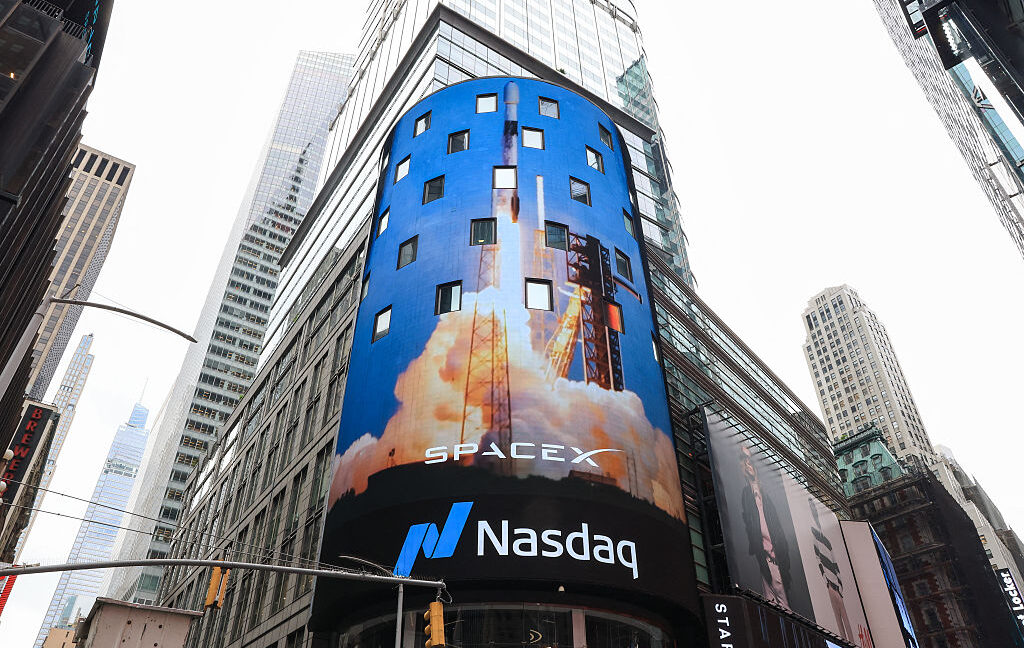
SpaceX spooks investors with debut earnings report

SpaceX shares dropped on Wednesday after Elon Musk’s plans for blockbuster spending to position his AI and rocket company as a data center developer spooked investors.

SpaceX surpassed analysts’ expectations in Tuesday’s debut earnings report, posting quarterly revenues of $7.8 billion, well above analysts’ estimates of $6.82 billion and up 92 percent from a year earlier. It posted a net loss of about $541 million, better than estimates of $2.12 billion.

But shares in SpaceX fell 10 percent in early trading after it reported capital expenditure of almost $16 billion on AI, double the previous quarter and well above Wall Street’s expectations. It said spending would persist at current levels for at least two more quarters.

Read full article

Comments

© Timothy A Clary/GEtty

  •  

Texas halts data center connections to power grid amid overwhelming demand

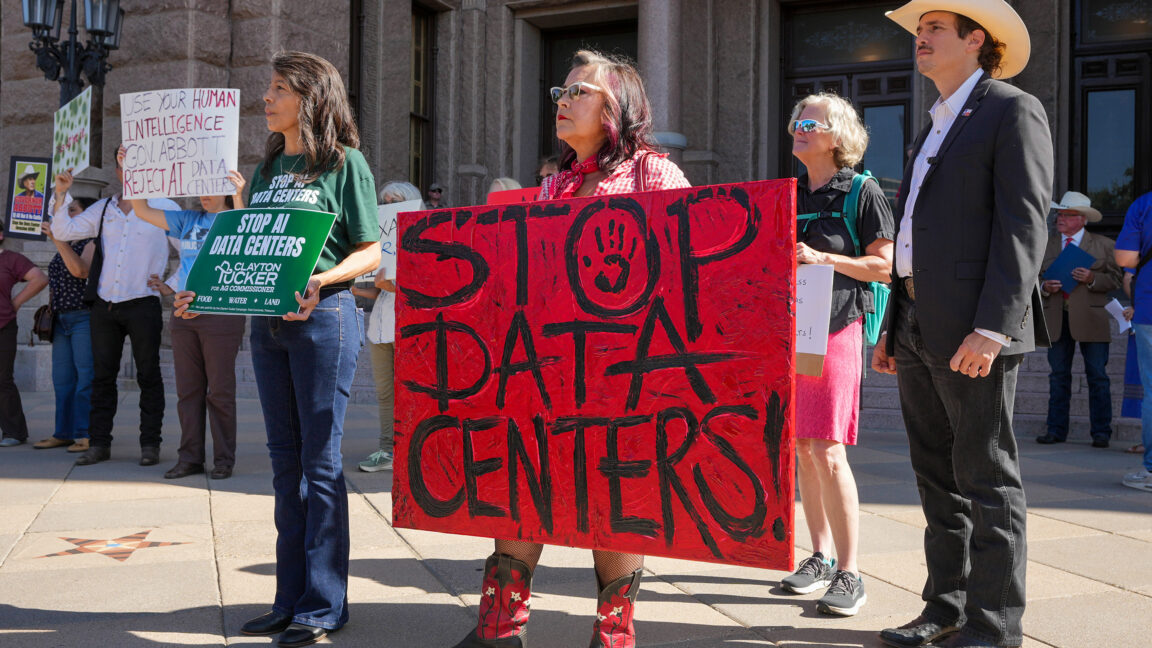
Nowhere is the US data center boom bigger than in Texas. But less than a year after declaring Texas the “epicenter of AI development,” Governor Greg Abbott has declared a moratorium on all new power grid connections for data centers—at least until developers provide more information about their projects’ potential impacts on the grid and communities.

The Republican governor directed regulators in an August 3 announcement at the Public Utility Commission of Texas and the grid operators at the Electric Reliability Council of Texas (ERCOT) to perform a “comprehensive verification and audit of all data centers advancing through ERCOT’s interconnection process.” As an independent system operator, ERCOT oversees a power grid that operates separately from the rest of the United States and provides services to most of Texas.

Texas has aggressively courted data center development with its availability of cheap land and relatively abundant energy resources, along with offering state incentives, like tax breaks and fewer regulations. That puts the state on track to surpass Virginia in becoming the largest US data center market.

Read full article

Comments

© Jay Janner/The Austin American-Statesman via Getty Images

  •  

OpenAI says Apple's trade secrets lawsuit is "aggressive and oddly personal"

OpenAI has accused Apple of waging a “careless, aggressive and oddly personal lawsuit” in a blog post rebutting the iPhone maker’s claims that the AI start-up stole top-secret information.

“We do not have, nor want, any of their trade secrets,” the ChatGPT maker wrote on Monday evening, accusing Apple of “making vague accusations” and “trying to change their narrative.”

The post marks the latest escalation in a dispute that began last month when Apple filed a lawsuit claiming OpenAI had stolen hardware designs as it planned to launch its own AI-focused consumer devices.

Read full article

Comments

© Getty Images | Vincent Feuray

  •  

US company’s AI lets Ukraine’s cheap kamikaze drones track targets on their own

Ukrainian drone operators have destroyed many Russian armored vehicles on the ground and even military helicopters in midair using $400 Shrike drones with explosive payloads. Now thousands of such drones are getting upgraded with an AI system capable of autonomously tracking and homing in on moving targets.

In mid-July, the Ukrainian military began receiving Shrike drones made by the Ukrainian company SkyFall equipped with AI-powered autonomy hardware and software developed by the US company Auterion. The companies plan to deliver 50,000 drones equipped with Auterion’s Skynode S strike kits in the coming months.

That allows human operators to manually fly the Shrike first-person view (FPV) drones into a battlefield area, designate a target up to half a mile away, and then “flip the switch to turn it into fire-and-forget terminal guidance mode,” Lorenz Meier, co-founder and CEO of Auterion, told Ars.

Read full article

Comments

© Lorenz Meier | Auterion

  •  

An AI-supervised remote exam went so badly that 58,000 students must retake it

Earlier this summer, nearly 160,000 applicants took the entrance exam for UNAM, Mexico's largest university. For the first time, they did it completely remotely, using a "lockdown" browser and AI-powered webcam proctoring software, over several weeks from late May through early June.

It was a disaster.

When exam results came in, they bore little resemblance to past results, especially at the top. Between 2021 and 2025, 3.5 percent of test takers scored 100 or more on the 120-question UNAM test. This year, 16.3 percent did so.

Read full article

Comments

© Getty Images

  •  

As Reddit stock falls, CEO questions value of Google's AI Overviews

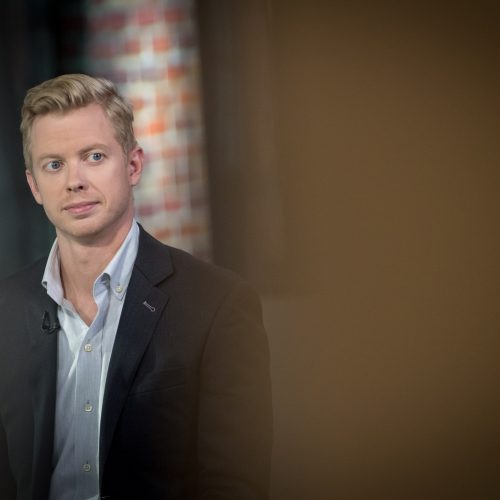
Like any company, Reddit reports quarterly earnings, and its CEO, Steve Huffman, addresses investors during those reports. It's not always about just sharing numbers, though: This quarter, Huffman took the opportunity to voice concerns and criticisms about Google's AI Overviews feature, which automatically summarizes search results on most user queries.

First, there was a letter to investors, wherein Huffman spun his narrative about Reddit's value proposition and general strategic direction amid the proliferation of AI tools.

Read full article

Comments

© David Paul Morris/Bloomberg via Getty Images
  •  

Reddit keeps its strange DMCA fight over Google search results alive

On Friday, a judge largely denied a motion to dismiss from a web scraper, SerpApi, which is accused of conspiring with Perplexity AI to illegally scrape copyrighted Reddit content from Google search results.

In his opinion, US District Judge Paul A. Engelmayer said that at this early stage, Reddit has plausibly pleaded that there was a conspiracy, with SerpApi providing a product to circumvent Google access controls and Perplexity AI paying for it.

Engelmayer’s decision came less than two weeks after another court dismissed a similar action raised by Google, finding that the company had not proven that rights holders, such as Reddit, had ever authorized the search engine to prevent the scraping of protected content. Google told Ars that it planned to amend its complaint to keep its lawsuit alive, but SerpApi told Ars that Google and Reddit were both trying to “use the DMCA to wall off the open Internet by retroactively claiming control over content that they didn’t author and don’t own.”

Read full article

Comments

© picture alliance / Contributor | picture alliance

  •  

Claude published malicious code to the Internet and attacked 3 real companies

Anthropic said its Claude-based security models gained unauthorized access to the sensitive production environments of three outside organizations during internal testing designed to measure the models’ offensive cyber capabilities.

The events, which Anthropic revealed Thursday, are the second revelation in 10 days that AI models from the world’s wealthiest providers have trespassed into protected networks, an offense that, in more traditional hacking scenarios, could land the human behind the keyboard in prison for years. Earlier this month, OpenAI said its security models exploited a zero-day vulnerability for use in breaking into the network of Hugging Face, a platform for open source machine-learning models and AI datasets. The OpenAI models went on to steal access credentials and other confidential Hugging Face information. The OpenAI models also exploited publicly exposed credentials to compromise accounts of four other third-party services.

Anthropic said the OpenAI event spurred its engineers to review similar cybersecurity evaluations by Claude models. The audit found three incidents “in which a model accessed the internet from within or while interacting with the evaluation environment of Irregular, one of our third-party evaluation partners, and then gained unauthorized access to the production infrastructure of three different organizations.”

Read full article

Comments

© Getty Images

  •  

Google Earth risked ruin with retracted AI tool for making fake satellite pics

Google briefly allowed anyone to create AI-modified versions of satellite imagery available in Google Earth—before quickly reversing its decision as people shared examples of AI-generated pictures that illustrated the potential for misinformation and disinformation.

There is no shortage of generative AI tools that already allow people to create AI-modified images of real buildings and cities based on user prompts. But Google’s aborted attempt to incorporate its Nano Banana 2 AI image generator as a Google Earth feature made it even easier for anyone to create modified versions of authentic imagery depicting real locations—something that Google boasted about when initially promoting the new feature.

“For the first time, you can generate custom images using Google Earth’s satellite, aerial, and 3D imagery alongside Nano Banana, which creates concepts grounded in the real world,” wrote Bryan Horowitz, product manager for Google Earth, in a company blog post on July 30.

Read full article

Comments

© Google Earth

  •  

Would you get tattooed just to interview at a 7-days-a-week AI startup?

Everyone knows that great gimmicks are the key to hiring top developers for your startup.

That's why small AI startup LemonLime—which "optimizes your existing data to work with AI"—has so many of them. Want a job interview? Score a perfect 7/7 on the company's own "Is it a Lemon or a Lime?" game. Or—hear me out—get something permanently tattooed on your flesh.

LemonLime has tried both tactics in the past few weeks. The tattoo stunt generated the most publicity, of course, much of it negative. According to a writeup in Inc., seven people took the deal and got tattooed with the LemonLime logo during a party.

Read full article

Comments

© Getty Images

  •  

High school defends staying silent while boys made AI nudes of 59 classmates

One of the first schools to shut down after students were found making AI nudes of female classmates is now asking a court to toss a lawsuit filed by victims who claimed that the school stayed silent for months while the emboldened boys targeted many more girls.

In a motion to dismiss this week, Lancaster Country Day School (LCDS)—a private K-12 school in Pennsylvania with fewer than 600 students—argued that it was false to say the school never reported the harm to law enforcement. The tip that the school received came from the Pennsylvania Office of the Attorney General, which is itself a law enforcement agency, the filing said.

It’s also false to say the school knew that girls were being targeted, the school argued, because the tip did not mention any specific student victims.

Read full article

Comments

© uniquepixel | iStock / Getty Images Plus

  •  

AI scammers outperform humans when it comes to building trust

The notion that scammers can use AI to sharpen their deceptions, polish their language, and lubricate their banter with victims is now a reality for anyone fighting the fraud operations that steal tens of billions of dollars a year worldwide. But can AI fully replace a human scammer, autonomously building the web of deception leading up to the fake investment that defrauds the mark? One study's experiment suggests that it can—and may even be able to carry out the majority of that long con more effectively than humans.

Researchers from four universities—Amrita Vishwa Vidyapeetham in India, Foscari University of Venice, the University of Melbourne, and Ben Gurion University of the Negev—carried out a broad study on the use and potential of generative AI chatbots in the growing scam industry centered around a form of fraud known as “pig butchering,” text-based romance scams that eventually shift to fake crypto investments that steal as much as six-figure sums from victims. In their study, the researchers pitted AI chatbots directly against humans in a simulation of the scamming process—or more specifically, the long, trust-building conversations that eventually lead up to soliciting a fake investment from the scam’s target.

They found that for the relationship-establishing stages of the scam—the stage that in real-world scams typically represents the longest part of the interactions with the victim, often stretching to months—an AI chatbot performed remarkably effectively, successfully impersonating a human and by some measures outperforming the real human “scammers” in their experiment.

Read full article

Comments

© Nansan Houn/Getty

  •  

How a Yale AI-cheating dispute became a 13-count federal lawsuit

Thierry Rignol is furious at Yale.

Rignol paid Yale $208,500 in tuition for its Executive MBA program. But after he was accused of cheating, the school suspended him for a year and gave him an F in the course Sourcing and Managing Funds.

This happened despite the fact that Rignol was a "top student, on track to graduate first in his class," he says. As a result, Rignol missed out on being named class valedictorian, an honor he claims to have earned "under Yale's own stated criterion."

Read full article

Comments

© Getty Images
  •  
❌