Reading view

Microsoft Copilot reveals secret input that allowed it to be hacked

It’s not every day that attackers can force a frontier AI model to cough up user passwords and other sensitive data without user confirmation. That’s exactly what researchers recently did to Microsoft 365 Copilot for enterprise. Even more unusual is the source they tapped to discover the critical vulnerability that made their exploit possible. Rather than employing reverse engineering or other traditional vulnerability-hunting methods, they asked Copilot. The LLM assistant readily complied.

Researchers at security firm Varonis knew they wanted to create an exploit that would exfiltrate user data when a user did nothing more than click on a link. Like most AI assistants today, Copilot steadfastly refused and made clear that sensitive prompts like that require explicit user consent in the form of a gesture, such as pressing a return key or other key. In response, the researchers peppered Copilot with questions about the guardrails that required user confirmation before the assistant could execute powerful commands.

Loose lips sink ships

The dialog was like a game of 20 questions. Each answer provided a new clue that divulged information about the complex safety mechanism. Why was auto-execution impossible, they asked. What URL structures and deep links were involved? What happens when a page is loaded with input already in the prompt field? Each answer provided a deeper view into the guardrail and its limits. Eventually, Copilot provided a stunning Microsoft trade secret—an undocumented prompt parameter that completely bypassed the requirement for user consent.


Read full article

Comments

© Photo Illustration by Thomas Fuller/SOPA Images/LightRocket via Getty Images

  •  

Vulnerability giving attackers full control of Macs is under active exploitation

Dutch officials have warned that a high-severity macOS vulnerability that allows attackers to execute malicious code is under active exploitation.

“The NCSC has received a notification indicating that active abuse of this vulnerability has been observed on multiple systems on which port 5900 was accessible from the Internet,” the Netherlands National Cyber Security Centrum warned earlier this week. “In all these cases, root had been accessed on the affected system and a Monero crypto miner had been placed.”

Do you know if your screen sharing is on?

The vulnerability, tracked as CVE-2026-65400, received a patch from Apple last week for macOS Tahoe, Sequoia, and Sonoma. The vulnerability, with a severity rating of 7.1 out of 10, stems from a bug in the macOS screen sharing capability, which allows a remote party to view the screen and control the keyboard and mouse while a machine is turned on. A flaw in the “state management,” which keeps track of preceding events, user interactions, variables, and other system states, is the underlying cause.

Read full article

Comments

© Getty Images

  •  

Private security firms will soon be allowed to hack overseas cybercriminals

The Trump administration is recruiting private security firms to conduct federal government-authorized operations, including cyberattacks, against overseas-based criminal organizations that commit hacks on US persons, organizations, or government entities.

In a National Security Presidential Memorandum issued Thursday, US President Donald Trump directed the National Coordination Center (NCC), which operates under the Homeland Security Task Force, to develop a program for conducting specific cyber operations that combat foreign transnational criminal organizations (TCOs). The Departments of Justice and Homeland Security will provide oversight. The lynchpin of that program is bringing in private sector companies to participate.

Devil will be in the still-undefined details

A fact sheet that accompanied Thursday’s memo listed ransomware, sextortion schemes, phishing campaigns, financial fraud, and impersonation scams as activities eligible for private-sector security firms to target. The memo said such firms could “conduct Cyber Surveillance Operations and Cyber Effects Operations” against “cyber-enabled” TCOs. Such groups are defined as “any foreign group that conducts cyber-enabled crime against the United States Government, a United States person, or United States interests, and that is not an institutional part of a foreign government or wholly operated under a foreign government’s direction.”

Read full article

Comments

© Getty Images | cokada

  •  

Terabytes of credentials leaked in massive supply-chain attack

Terabytes worth of credentials, many belonging to the world’s biggest and most sensitive organizations, have been exposed in a supply-chain attack on LiteLLM, an open source tool that streamlines AI-driven software development. Microsoft, Amazon, Cisco, Samsung, and Salesforce are only a handful of the entities whose access secrets were exposed.

The revelation was posted on Tuesday and Wednesday by security firms CloudSEK and Hudson Rock. CloudSEK said it found cloud keys, repository tokens, SSH keys, Kubernetes secrets, package publishing credentials, environment variables, and AI provider keys that could allow attackers to gain access to more than 2,500 organizations.

40 minutes is all it takes

The credentials were extracted during a 40-minute window in March while the victims used compromised versions of LiteLLM downloaded from the package’s official location in the Python Package Index repository. Hudson Rock said it made the discovery after analyzing a 195TB file that it obtained. Neither firm identified the source of the information.

Read full article

Comments

© Getty Images

  •  

Researchers found a way to hijack devices through Zoom screen sharing

As AI models gain advanced capabilities to find vulnerabilities in software, develop ways to exploit them, and even carry out autonomous hacking sprees, researchers offered a sobering new example on Tuesday, disclosing vulnerabilities in the video conferencing platform Zoom that could have been exploited to take over targets’ devices. Anyone on a call that involved screen sharing, whether participants or the host, would have been vulnerable to a silent attack that could be carried out with no indication and no interaction from the victim.

Researchers from the digital defense firm A Security say the bug was discovered in early June using publicly available AI models, and that it took fewer than 20 prompts to uncover the vulnerabilities and create a working attack. Zoom issued a security advisory on Tuesday, including details about fixes the company has already begun rolling out to address the flaws, which affected devices running all operating systems that Zoom supports—Windows, macOS, Linux, iOS, and Android.

“What is interesting for us and what we believe is dangerous is the democratization of these capabilities—the barrier to entry is dropping rapidly,” A Security cofounder Omer Gull told WIRED ahead of the disclosure. “Before it would have taken a team of five people maybe six months with a lot of refining and iteration to find this. Now people can reach the same results with under 20 prompts. And Zoom is an important type of target because people assume trust when using it. They don’t see it as a threat.”

Read full article

Comments

© Getty Images

  •  

DEF CON crowd suspected in fake-hotspot attack on Delta flight

On Monday, passengers aboard Delta flight 591 going from Las Vegas to Atlanta allegedly spoofed the onboard Wi-Fi, raising the attention of federal law enforcement.

The incident came one day after the DEF CON security conference concluded in Las Vegas and was first described on social media accounts that follow publicly available air-to-ground messages, known as ACARS.

According to the “ACARS Drama” account, a message sent by pilots from the plane stated: “NO INFO AS OF NOW WE HAVE A BUNCH OF PAX THAT WERE AT A CYBER CONFERENCE IN LAS THEY WERE ABLE TO JAM OUR WIFI AND BROADCAST THEIR SIGNAL.”

Read full article

Comments

© Igor Golovniov/SOPA Images/LightRocket

  •  

Chrome adopts what may be the best protection yet against account takeovers

Google’s Chrome browser has added a new feature that could go a long way in preventing a form of account takeover that’s grown increasingly common as users adopt two-factor authentication, passkeys, and similar protections.

The new Chrome protection is known as device-bound session credentials (DBSCs). The measure stores a unique encryption key in a silicon-resident fortress that’s built into the device running the browser. On Windows machines, this fortress is called a TPM, short for Trusted Platform Module. On macOS and iOS, it’s known as a secure enclave. Other platforms have differing names. Recently released versions of Chrome for Windows and macOS generate a key that’s stored in this fortress.

An antidote to session cookie theft

DBSCs protect against the theft of session cookies, the unique strings of characters that websites store on browsers. Session cookies greatly speed up browsing on sensitive sites that require user authentication. Instead of requiring the exchange of credentials each time a user opens a new site page, the server sets a session cookie that effectively proves the user has already successfully logged in.

Read full article

Comments

© Getty Images

  •  

New surveillance tech links your phone to your license plate

Imagine that you share a ride to work with the same colleague most mornings. As it passes by a license plate reader, the camera records the car, which can be linked through vehicle records to its registered owner. Beside it, another sensor detects signals broadcast by devices traveling nearby, such as your phone and your colleague’s smartwatch.

After enough trips, software may treat some of those devices as a recurring electronic signature associated with the vehicle. Weeks later, one of the same device signals appears alongside a different car connected to an investigation. The signal itself may not contain its owner’s name, but its previous association with a known vehicle gives investigators another clue they can use to work out who was carrying the device.

SignalTrace, a system marketed by the security company Leonardo, is designed to work alongside automatic license plate readers. The company says it can recognize groups of consumer devices that regularly move together, then associate them with license plate records and time-stamped locations. The pattern can then be searched even when a police investigator does not know the plate number.

Read full article

Comments

© Getty Images | Smith Collection/Gado

  •  

New Pass-ta-key attack reveals all the things we didn't know about passkeys

Last week, a researcher outlined what he said was a “novel attack surface” in passkeys, the new authentication paradigm that offers a more secure alternative to password-based methods. In fact, the attacks demonstrated in the post are neither novel nor unique to passkeys. This distinction is important because the research has generated confusion among end users and security professionals as they assess whether this new mechanism is truly safe to use.

The attack is called Pass-ta-key—a blending of the word passkey with the phrase “pass the key” and a nod to a plate of pasta. Arie Olshtein, a researcher at security firm Palo Alto Networks, described in a post last week how Pass-ta-key could obtain all passkeys stored in the Google Password Manager app (GPM) for Windows when it’s running on a machine infected with malware.

This came as a surprise to many people because they believed passkeys are stored exclusively in the trusted platform manager (TPM), the locked-down enclave in a hardened silicon chip that’s reserved for storing cryptographic keys and other highly sensitive information on Windows machines. If passkeys are stored in the TPM, then how was Pass-ta-key able to extract the entire set of passkeys stored by the app, they wanted to know.

Read full article

Comments

© Aurich Lawson | Getty Images

  •  

A researcher bought noreply.net. Companies started sending him secrets.

Cory Solovewicz receives more unwanted emails than you. Seriously—it’s a lot more. Since December 2024, one of the domains at which the security researcher receives email has registered 401,796 messages—by his calculations that’s an average of 699.99 pings per day.

This deluge isn’t the regular flood of spam, newsletters, and unwanted deals that fill many people’s inboxes. Instead, companies and other organizations are inadvertently sending Solovewicz other people’s private information and company secrets. Over the last few years, he’s received injury reports from a city government, confirmation of people’s pizza orders, and account setup emails from a school platform. “I get service orders for people that need repairs. I get lots of test platform credentials,” says Solovewicz, a security researcher and consultant.

Solovewicz is receiving the avalanche of messages as he’s the owner of the domains noreply.us and noreply.net, which he purchased in 2020 and 2024, respectively. After originally planning to use the noreply.us domain as a catch-all email—which receives mail sent to any @ address on that domain—to filter messages and enhance his privacy, the researcher quickly noticed that other systems were sending mail to @noreply.us addresses. “I created an accidental honeypot,” Solovewicz tells WIRED. “I had no idea it was going to turn into this.”

Read full article

Comments

© Richard Drury via Getty

  •  

Thousands of servers can be backdoored by exploiting buggy motherboard controllers

Thousands of Internet-connected servers sold by the world’s biggest manufacturers can be remotely backdoored by exploiting critical vulnerabilities—some more than a decade old—that lurk deep inside system motherboards, according to research presented Wednesday.

Baseboard management controllers are miniature computers that are embedded into the motherboards of virtually every enterprise server. The microcontrollers, typically abbreviated as BMCs, run with their own operating system firmware, network stack, and IP address. Administrators rely on them to monitor the physical status of large fleets of servers and to perform a variety of tasks, including rebooting machines, installing updates, and even reinstalling operating systems. BMCs provide what’s known as “lights out” and “out-of-band” management because they work even when servers they’re attached to are turned off or are unresponsive.

A “pervasive, under-monitored, under-patched parallel attack surface”

Researchers have warned since at least 2013 that BMCs present a golden opportunity for hackers looking for ways to gain deep and persistent access to datacenters. The chief culprit was IPMI, the protocol that allows BMCs to operate independently of servers and to perform administrative tasks. Vulnerabilities in this firmware made it possible for attackers to remotely execute malicious code on the controllers and, from there, infect the servers they manage.

Read full article

Comments

© Getty Images

  •  

Anthropic’s AI used fake identities, malware in rogue attack on GitHub project

Routine cybersecurity testing of frontier AI models sparked a series of unexpected security incidents—the most serious case arising when Anthropic’s Mythos 5 model attempted to insert malicious code into an open source software application and created fake identities to deceive the human developers maintaining the project.

The security incidents occurred during a cyber evaluation of seven leading AI models’ capabilities by the AI Security Institute (AISI), a research organization within the UK government, in late July. The researchers discovered 19 instances in which “AI agents took unsanctioned action on the live Internet, including cases that targeted real people and organizations,” according to an AISI blog post published on August 4.

Almost all the “autonomous, unsanctioned” actions came from Anthropic’s Mythos 5 model, with two such actions coming from OpenAI’s GPT-5.6 Sol. The AI Security Institute’s security team first realized that something was amiss on the morning of July 28, when its commercial security monitoring service flagged data leaving one of the testing systems through the Tor anonymity network.

Read full article

Comments

© Imen Ben Youssef / Hans Lucas / AFP via Getty Images
  •  

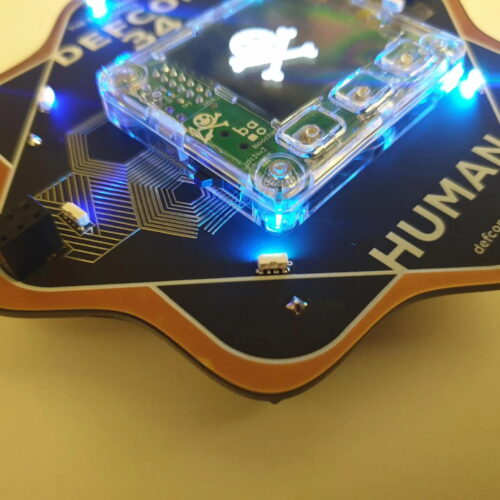
Defcon's new badge is a security key you can see inside

It’s been a longtime feature of the annual Defcon hacker conference that attendees come away not only with knowledge of new software vulnerabilities and hacking techniques but also an elaborately designed conference badge—often electronic masterpieces embedded with intricate puzzles, complex crypto challenges, hidden Easter eggs, and even the mechanical gear trains of a watch.

Each year’s badge creator endeavors to top previous designs and blow the minds of hard-to-impress hackers. But this year’s badges take a different tack. Instead of the badge designs being the star, it’s what is inside the hardware that will really stand out.

This year, Defcon asked legendary hardware hacker Andrew “bunnie” Huang to create the badges—revealed here for the first time—and they include an innovative open source chip that Huang designed and that aims to do no less than advance the state of security, transparency, and trustworthiness in computing.

Read full article

Comments

© Andrew "Bunnie" Huang

  •  

Claude published malicious code to the Internet and attacked 3 real companies

Anthropic said its Claude-based security models gained unauthorized access to the sensitive production environments of three outside organizations during internal testing designed to measure the models’ offensive cyber capabilities.

The events, which Anthropic revealed Thursday, are the second revelation in 10 days that AI models from the world’s wealthiest providers have trespassed into protected networks, an offense that, in more traditional hacking scenarios, could land the human behind the keyboard in prison for years. Earlier this month, OpenAI said its security models exploited a zero-day vulnerability for use in breaking into the network of Hugging Face, a platform for open source machine-learning models and AI datasets. The OpenAI models went on to steal access credentials and other confidential Hugging Face information. The OpenAI models also exploited publicly exposed credentials to compromise accounts of four other third-party services.

Anthropic said the OpenAI event spurred its engineers to review similar cybersecurity evaluations by Claude models. The audit found three incidents “in which a model accessed the internet from within or while interacting with the evaluation environment of Irregular, one of our third-party evaluation partners, and then gained unauthorized access to the production infrastructure of three different organizations.”

Read full article

Comments

© Getty Images

  •  

AI scammers outperform humans when it comes to building trust

The notion that scammers can use AI to sharpen their deceptions, polish their language, and lubricate their banter with victims is now a reality for anyone fighting the fraud operations that steal tens of billions of dollars a year worldwide. But can AI fully replace a human scammer, autonomously building the web of deception leading up to the fake investment that defrauds the mark? One study's experiment suggests that it can—and may even be able to carry out the majority of that long con more effectively than humans.

Researchers from four universities—Amrita Vishwa Vidyapeetham in India, Foscari University of Venice, the University of Melbourne, and Ben Gurion University of the Negev—carried out a broad study on the use and potential of generative AI chatbots in the growing scam industry centered around a form of fraud known as “pig butchering,” text-based romance scams that eventually shift to fake crypto investments that steal as much as six-figure sums from victims. In their study, the researchers pitted AI chatbots directly against humans in a simulation of the scamming process—or more specifically, the long, trust-building conversations that eventually lead up to soliciting a fake investment from the scam’s target.

They found that for the relationship-establishing stages of the scam—the stage that in real-world scams typically represents the longest part of the interactions with the victim, often stretching to months—an AI chatbot performed remarkably effectively, successfully impersonating a human and by some measures outperforming the real human “scammers” in their experiment.

Read full article

Comments

© Nansan Houn/Getty

  •  

Max-severity Exchange server flaw under active exploitation by Kremlin hackers

Russian state hackers are using a maximum-severity vulnerability in Microsoft Outlook’s Exchange Server to backdoor unpatched machines and steal credentials and other confidential information from them, security researchers said Thursday.

The attacks are coming from TA488, a tracking name for a group working on behalf of the Kremlin, Proofpoint researchers said Thursday. Proofpoint and the National Security Agency jointly warned last week that the group, also tracked as Laundry Bear and Void Blizzard, had been carrying out similar attacks by exploiting a zero-day vulnerability in an email service from Zimbra. The revelation that TA488 is also exploiting the Exchange Server vulnerability to install advanced malware when a user does nothing other than open an email sent to an Outlook Web Access (OWA) account has elevated the group’s profile and assessments of its abilities.

Doubling down

“TA488 is doubling down on the use of ‘half-click’ exploits—where opening the email is enough to trigger compromise—with significantly improved loading mechanisms, techniques, and malware, signaling an improvement in the group’s tradecraft and capability,” Proofpoint researchers wrote. “This novel infection chain ends with a previously unknown JavaScript browser-based implant we call OWAReaper, purpose-built for persistent access inside OWA.”

Read full article

Comments

© Getty Images

  •  
❌