Reading view

Anthropic "pauses" token-based billing for its Claude Agent SDK

Last month, Anthropic announced a billing change that would have substantially increased costs for heavy users of its automation-focused Claude Agent SDK, including many third-party apps. On Monday, though, Anthropic abruptly announced it had paused those pricing changes just as they were set to take effect, allowing Agent SDK users to continue drawing from the more generous usage limits in their existing Claude subscriptions.

The plan, as announced on May 13, would have treated usage of the Claude Agent SDK (including via third-party apps and the programmatic "claude -p" command) separately from "standard" Claude usage via the chat interface or the official Claude CLI. At the time, Anthropic said that, as of June 15, that kind of outside SDK usage would be billed at Anthropic's prevailing API rates, with subscribers receiving a simple monthly usage credit equal to their subscription price.

That would have been a major change from the current setup, where Agent SDK use is limited only by the standard weekly caps applied to a user's current Claude subscription tier. Those generous limits allow power users to squeeze a lot more usage out of those paid subscriptions than they would get by paying the same price for API fees. One analysis suggests that Claude Opus users start saving money from their subscription after just two to three messages per day, and that their subscription could be worth many multiples of its monthly cost in API usage.


Read full article

Comments

© Anthropic

  •  

Pentagon boasts of using AI to write reports mandated by Congress

The US Department of Defense has a lot of congressionally mandated homework to do every year involving hundreds of required reports on various national security topics. But Pentagon officials have been proudly describing a new shortcut—using generative AI tools to write such reports for Congress.

Pentagon Chief Technology Officer Emil Michael highlighted AI-generated reports to Congress as a key example of how the Department of Defense—stylized as the Department of War under the Trump administration—has adopted generative AI during an event hosted by the Hudson Institute think tank in Washington, DC, on June 12. The Pentagon has made AI tools, starting with Google Cloud’s Gemini for Government, widely available to members of all six military branches through the department’s bespoke GenAI.mil platform since December 2025.

“I have to report to Congress every year on this thing,” Michael said. “Let me load all the papers onto it and have it draft me a congressional report that would otherwise take 200 hours of staffing time and do it in five hours.”

Read full article

Comments

© SAUL LOEB / AFP via Getty Images

  •  

SpaceX to acquire AI coding platform Cursor for $60 billion

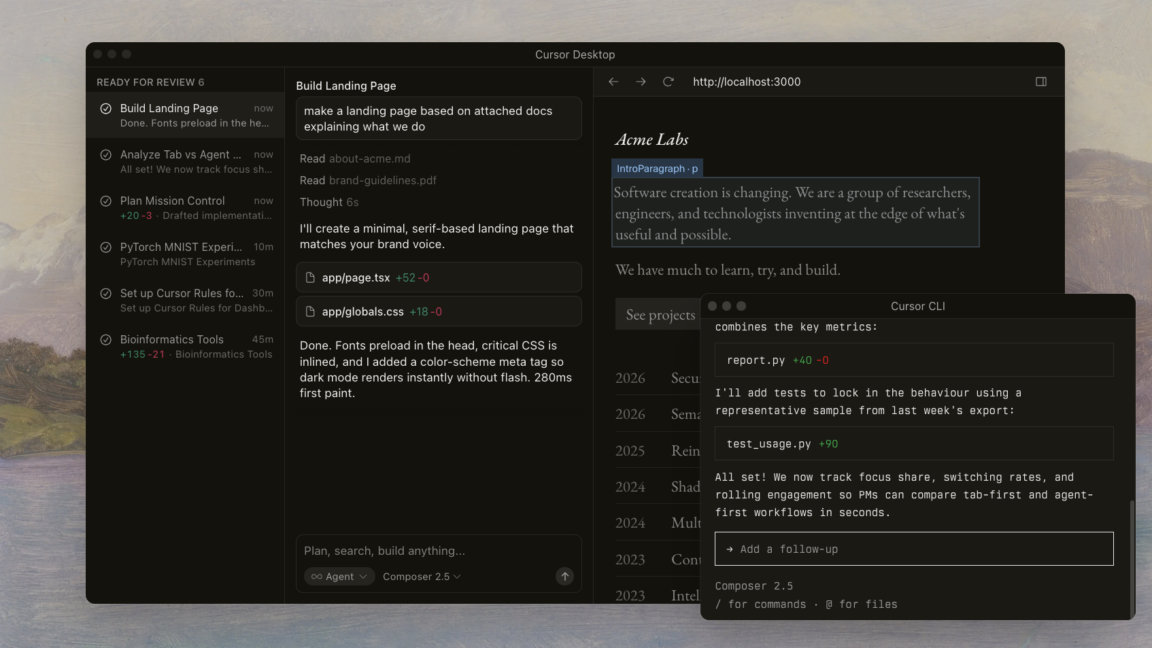
SpaceX will acquire AI coding tool Cursor for $60 billion in an all-stock transaction, the companies announced today. The deal is expected to close in the third quarter.

It comes just two days after SpaceX's unprecedented IPO and a few months after the merger of SpaceX and xAI, which brought a significant restructuring of xAI.

Cursor was one of the first tools to fully bake features that leverage large language models into an IDE. It's a branch of Visual Studio Code with heavy AI integration. However, incumbent platforms and bigger AI companies have since rolled out comparable features.

Read full article

Comments

© Cursor

  •  

Leaked financial docs show OpenAI is losing billions of dollars a year

As OpenAI files SEC paperwork ahead of an expected initial public stock offering, newly leaked financial documents show a company with quickly growing revenues that are currently being overwhelmed by even larger expenses.

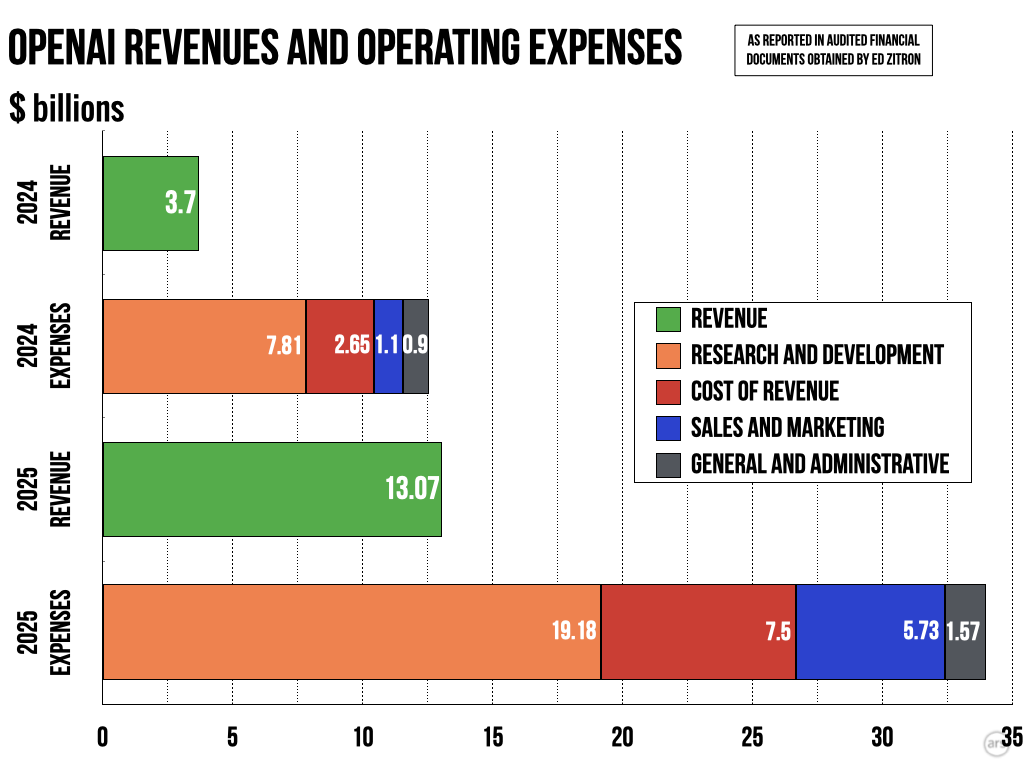
The audited financial statements, obtained by independent journalist Ed Zitron, show OpenAI's reported revenue growing from $3.7 billion in 2024 to $13.07 billion in 2025. The Financial Times, which reviewed the same documents, writes that the company's monthly revenues had grown to nearly $2 billion by the end of 2025, suggesting that its ongoing revenue rates continued to grow throughout the year.

R&D expenses alone still easily outpace OpenAI's quickly growing revenues. Credit: Ars Technica

But the company's fast-growing revenues are still dwarfed by its even more significant expenses. OpenAI's total revenues in both of the last two years were outpaced by research and development alone, which grew from a $7.81 billion line item in 2024 to a massive $19.18 billion cost in 2025. Those numbers seem to reflect the significant costs OpenAI incurred in training new models and include $10.59 billion in R&D costs paid to Microsoft alone in 2025.

Read full article

Comments

© Getty Images

  •  

Critical Copilot vulnerability allowed hackers to steal 2FA code from users

Last Tuesday, Microsoft patched a vulnerability it rated as max critical in its M365 Copilot AI platform. On Monday, the researchers who discovered the vulnerability and reported it to Microsoft revealed how their proof-of-concept exploit could retrieve 2FA codes and other sensitive data from emails accessible to Copilot.

Microsoft and other LLM providers have been unable to prevent their products from complying with malicious requests to reveal data. The root cause: AI bots are unable to distinguish between instructions provided by users and those snuck into third-party content the models are summarizing, drafting responses to, or using to perform other actions on behalf of the user. With no way to secure this crucial boundary, Microsoft and its peers are left to erect complicated and ad hoc guardrails designed to rein in the consequences of this incurable gullibility.

Jumping over guardrails

One guardrail built into Copilot and most other LLMs prevents them from submitting web forms, sending emails, and taking similar actions that can be used to exfiltrate data from the user. To work around this, LLM hackers turned to markup language, which, among other things, allows users to add formatting elements such as headings, lists, and links to text without the need for HTML tags. Another workaround is to wrap sensitive data inside HTML tags such as <img> and <form>. In either case, a web request showing the data hits the attacker’s web server, where the secret information is captured in logs.

Read full article

Comments

© Photo Illustration by Thomas Fuller/SOPA Images/LightRocket via Getty Images

  •  
❌