Reading view

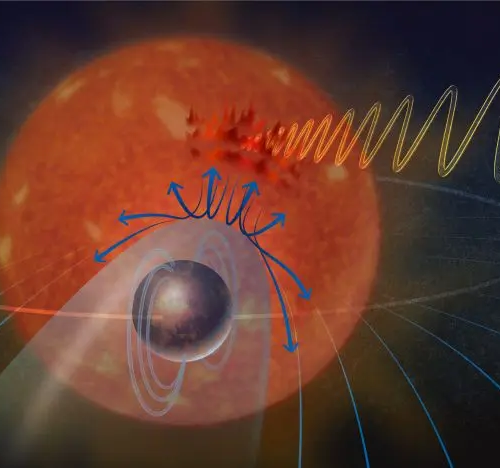
Planet orbits so close to its star that their magnetic fields connect

For most of human history, our view of "close to the Sun" was defined by the orbit of Mercury, with its 88-day orbit and barren, baking surface. But from the moment we started discovering exoplanets, it became very clear that our own Solar System was anything but a guide to the rest of the galaxy. Planets with orbits only a few days long are strikingly common, with the proximity to the star creating things that seem bizarre from our perspective: metal vapor in the atmosphere, or atmospheres puffed out to ridiculously low densities.

Now, we can apparently add an additional oddity: overlapping magnetic fields. Researchers have found a star/planet combo that experiences periodic brightening, which they ascribe to the interactions between the magnetic fields of both bodies.

Looking for repetition

This is one of those cases where theory came before discovery. People had already proposed that a planet orbiting close to its host star could interact with it if its magnetic field were sufficiently strong. And, in a number of cases, researchers have found evidence that this is happening, with one case of an extremely young star emitting flares seemingly in response to the orbit of its innermost planet.

Read full article

Comments

© NSF

  •  

The "sad inevitability" of Europe's heat wave

Europe is in the midst of its second big heat wave of the year, and it’s breaking more records. France just recorded its hottest day ever, with temperatures exceeding 44° Celsius in some places. Around 40 people have drowned in local water bodies, likely attempting to escape the heat, and thousands more are without electricity.

As temperatures hit a sweltering 36° in some regions of the United Kingdom, schools canceled classes and train delays abounded. United Nations Secretary-General Antonio Guterres described London as “cooking.” As the city hosts its annual Climate Action Week, the UK meteorological service has issued a red alert for multiple regions, signaling that exceptionally hot and humid weather is forecasted and likely to impact the general public. Switzerland and Spain have also issued warnings to residents.

Emma Howard Boyd, the former chair of the London Climate Resilience Review who now chairs the National Heat Risk Commission in the UK, said that when it comes to heat resilience in the country, the problem is not just homes—which are usually not air-conditioned.

Read full article

Comments

© Anadolu via Getty

  •  

New effort will get genome sequences for entire Endangered Species list

The US Endangered Species Act compels the government to identify species at risk of extinction and devise plans to restore populations and the habitats they depend on. It has seen some spectacular successes, such as the restoration of the bald eagle to much of its original range. But over 2,300 plant and animal populations remain on the list, requiring ongoing government intervention.

On Thursday, it was announced that all of those species would see their genomes sequenced and tissue samples preserved to aid future conservation efforts. The work will be done by a partnership between two unexpected parties. One is the US government, which has generally attempted to undercut the Endangered Species Act as part of its anti-regulatory efforts. It is joined by Colossal Biosciences, a biotech company that has a controversial take on what actually constitutes a species.

Colossal has always said it had a conservation focus, but its headline-grabbing efforts have been directed toward restoring species that have been driven to extinction. It intends to do that by developing a combination of gene editing and reproductive technologies that it expects it can profitably license. But its dire wolf announcement, in which only a tiny handful of genetic changes were edited in to grey wolves, have raised some questions about its seriousness regarding these efforts.

Read full article

Comments

© Adam Jones

  •  

Every Homo naledi we know of is female, and the implications are fascinating

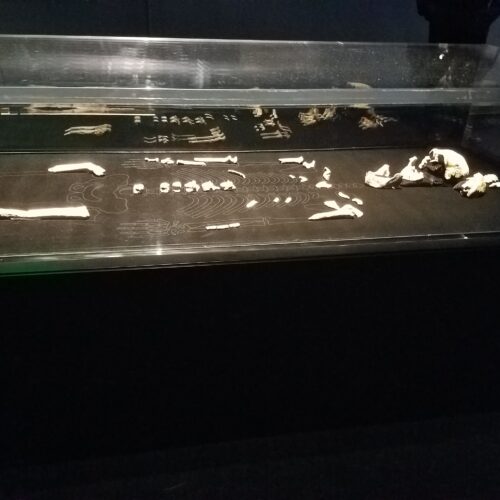
All the Homo naledi skeletons in Rising Star Cave are female, and that probably didn’t happen by accident.

In 2013, a team of anthropologists led by Lee Berger unearthed the remains of more than 20 small-bodied hominins (ancient relatives of humans), all 335,000 to 236,000 years old, from the Rising Star Cave System in South Africa. Excavations at Rising Star have sparked debate about whether these little hominins had all ended up in the caves by tragic accident, or whether they’d been carefully placed there by other members of their enigmatic species, dubbed Homo naledi.

Now there's a plot twist that may speak to how the remains got there: All of the hominins in Rising Star are female, at least according to the proteins in their dental enamel.

Read full article

Comments

© Kiona Smith

  •  
❌