
Reading view

Europe's free satellite service just made it easier to track wildfires

The wildfires afflicting communities across the world can now be tracked more easily by anyone using Europe’s free and open satellite imagery service—all thanks to a wildfire visualization script originating from nearly a decade ago.

The Copernicus Browser provides free access to the latest satellite imagery taken by the European Space Agency’s Sentinel satellites for the European Union’s Earth observation program. The three satellites of the Sentinel-2 mission have proven especially useful for wildfire monitoring by providing multi-spectral imaging at resolutions as granular as 10 meters in visible light and near-infrared bands—and the Copernicus Browser previously offered 10 default visualization layers using different combinations of spectral bands.

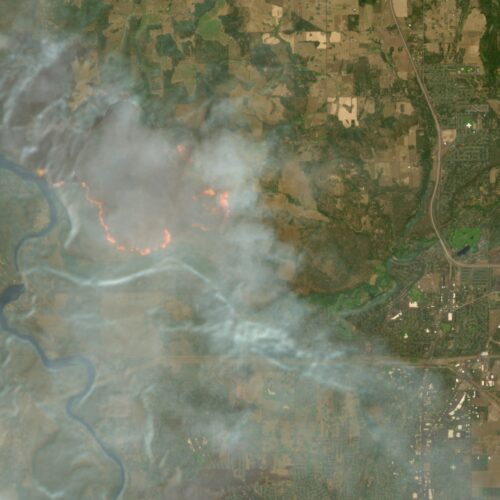
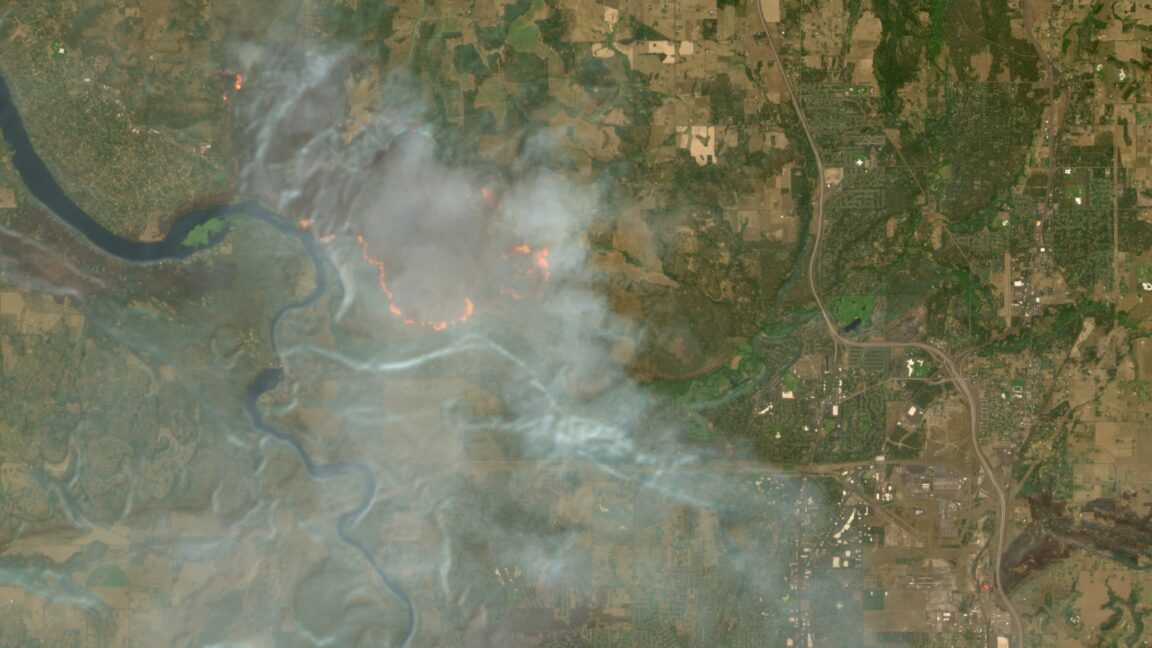
Now Copernicus Browser has also added a straightforward “wildfires” visualization layer for Sentinel-2 imagery that went live on August 4. Anyone clicking on this layer while looking at a wildfire location can see active fires in white or yellow, burning vegetation in red, and burned landscapes in dark brown or black.
Read full article

Comments

© European Union | Copernicus Sentinel-2

  •  

OpenAI’s expensive smart speaker will use moving parts to seem “more alive”

OpenAI’s upcoming smart speaker will probably cost over $300, “people familiar with the matter” have told Bloomberg’s Mark Gurman.

The generative AI company has “discussed” charging up to $400, Bloomberg, which has been reporting on the yet-to-be-announced smart speaker since July, said today. The publication said that OpenAI is viewing the smart speaker as a smartphone replacement.

OpenAI has declined to comment on its product roadmap.

Read full article

Comments

© Getty Images | NurPhoto

  •  

Remembering the pre-Google web, when search was an experiment

In the mid-'90s, the web was exploding, but finding anything of actual value on it felt like an elaborate negotiation with whatever proto-search engine happened to be standing closest to the door. Unlike now, when Google is widely seen as both portal and gatekeeper, sites like AltaVista, Lycos, Excite, HotBot, and Ask Jeeves promised to tame the chaos, each with its own suite of quirks, charms, and flaws.

The real story of pre-Google search is not that early engines were inferior. It's that they reflected a different Internet entirely, one where directories mattered, crawling was still an art, ranking was fragile, and the idea of “search” had not yet hardened into a single dominant interface.

A different kind of web

The first thing to remember about the pre-Google Internet is that there was no built-in assumption that you could search for everything. Many users found pages through Yahoo-style directories, bookmarks, newsgroups, email signatures, and links from site to site because the web was still small enough that human organization could compete with machine indexing. It was an era of Wild West-style discoverability. Search engines existed, but they were only one part of a larger ecosystem that blended curation and accident.

Read full article

Comments

© Aurich Lawson

  •  
❌