Reading view

Nobody needs AI to search the Internet, court says in ruling against Google

Potentially impacting all AI search engines and chatbots known to poorly paraphrase source links, a German court has ruled that Google is liable for false statements in AI Overviews.

The preliminary ruling came in a case flagged by The Decoder, where two publishers found that Google's AI Overviews incorrectly linked them to scams and other sketchy business practices. After smearing publishers by making affirmative statements like "Yes, [it] is known for dubious business practices and is often perceived as a scam," Google failed to correct the misleading output, even after the publishers sent a cease-and-desist letter earlier this year.

Google tried the usual arguments to shield itself from liability for false statements in AI Overviews, such as arguing that most users understand that AI outputs aren't always accurate and must be verified.

Read full article

Comments

© SOPA Images / Contributor | LightRocket
  •  

Racist comments targeting politicians tripled since Meta relaxed its rules

Last year, Meta radically overhauled the rules around what content it would allow on its platforms. The company claimed that its own efforts policing speech had gone too far and that it would relax the rules around what speech was allowed. “We have been over-enforcing our rules, limiting legitimate political debate and censoring too much trivial content and subjecting too many people to frustrating enforcement actions,” Joel Kaplan, Meta’s chief global affairs officer, wrote in a blog post at the time.

Over a year later, new research from the Center for Countering Digital Hate (CCDH) shows the immediate impact of these changes.

The researchers analyzed about 8 million Facebook comments and found that abusive and racist comments targeting both Republican and Democrat lawmakers tripled in the six months after the new rules were put in place. Some categories of abusive comments documented by the researchers saw even sharper rises, with violent threats and hate speech quadrupling during the same period.

Read full article

Comments

© Getty Images | Chesnot

  •  

Starlink charges $10 monthly hardware fee in move away from one-time purchases

Starlink has started charging a $10 monthly rental fee for hardware in a shift away from its longtime practice of selling hardware to customers for a one-time charge.

Starlink residential ordering pages now show an upfront hardware cost of $0 and a monthly kit fee of $10, similar to the hardware rental fees long charged by cable and telecom companies. Starlink hardware includes a terminal to receive satellite signals and a router to place in a user's home.

The monthly kit fee is in addition to Internet service prices, which Starlink recently raised by $5 to $10 per month. Starlink is charging $55 a month for 100Mbps, $85 for 200Mbps, and $130 for the "Max" tier that can go up to 400Mbps. Starlink also provides a professional-installation service for a one-time fee of $199, or for no additional charge if you subscribe to the Max plan.

Read full article

Comments

© Getty Images | John Keeble

  •  

Paramount accuses Netflix of "scorched-earth campaign" against WBD merger

Paramount Skydance is accusing Netflix of maintaining a campaign against its proposed acquisition of Warner Bros. Discovery (WBD).

In a June 5 letter (PDF) addressed to Jared A. Hughes, acting section chief of the Media, Entertainment, and Communications Section of the US Department of Justice's (DOJ's) Antitrust Division, and A. Maya Kahn, a trial attorney for the Antitrust Division, and first reported on by Politico today, Paramount chief legal officer Makan Delrahim accused Netflix of trying to influence stakeholders about the merger. The letter reads:

Indeed, Netflix’s panic-level response and scorched-earth campaign to try and poison regulators and other stakeholders against the Transaction shows just how seriously Netflix takes Paramount as a scaled competitor.

The letter from Delrahim, a former assistant attorney general for the Antitrust Division, is a response to a letter that The International Brotherhood of Teamsters sent to the DOJ in March. The teamsters' letter argued that Paramount and WBD's merger would threaten film and TV workers. The union, which has 1.3 million members, asked the DOJ to block the merger "unless substantial and enforceable safeguards are put in place to increase domestic production and protect jobs," per an announcement from the group.

Read full article

Comments

© Mike Cohen/Getty Images for The New York Times

  •  

One day after discovery, Meta pulls facial recognition code from its smart glasses

One day after WIRED revealed that Meta had quietly embedded an unreleased face-recognition system into an app installed on more than 50 million phones, the company removed it, according to a WIRED analysis of the latest version’s code.

The most recent version of Meta AI, a companion app for its line of smart glasses, strips out the unactivated software components that powered the system Meta internally called NameTag. The version published the day of WIRED’s report included several code libraries explicitly named for face recognition. Friday’s release includes none of them.

Andy Stone, Meta's vice president of communications, told WIRED on Monday that the feature is purely exploratory, adding: “No final decision has been made on what to do here, if anything.”

Read full article

Comments

© David Paul Morris/Bloomberg/Getty

  •  

Meta alleges NSO violated spyware injunction with new WhatsApp attacks

Meta today accused spyware maker NSO Group of violating a court order that barred it from targeting users of WhatsApp.

"WhatsApp caught and disrupted spear phishing attempts linked to NSO, a spyware firm blacklisted by the US government," WhatsApp owner Meta said in an announcement. Meta said it is asking a court "to hold NSO in contempt for violating a permanent injunction that barred them from ever targeting WhatsApp and its users."

NSO is an Israeli company that developed the Pegasus spyware. The US government added NSO to the Entity List in 2021, saying it “developed and supplied spyware to foreign governments that used this tool to maliciously target government officials, journalists, businesspeople, activists, academics, and embassy workers.”

Read full article

Comments

© Getty Images | stockcam

  •  

Man jailed for a month despite Flock showing he was 5 miles from crime scene

A San Diego police department is facing a lawsuit after jailing a man for a month based on a Flock camera alert that cops allegedly should have known, based on the timestamp, did not depict the car that they were looking for.

Last November, Hugo Parra was arrested on felony charges after San Diego police relied on Flock data and a witness statement to wrongly connect him to an attempted carjacking at gunpoint, the Times of San Diego reported. Cops were looking for a red Alfa Romeo car with tinted windows and a man wearing a gray hoodie, and Parra happened to be wearing a white hoodie while riding in a friend's car that roughly matched the vehicle description.

Although Flock cameras can capture license plate data, cops did not have even a partial plate to help them verify if the car was involved in a violent crime. But the Flock data cops used to justify the arrest actually showed that Parra was five miles away at the time of the crime, Parra's attorney, Alex Coolman, told the Times of San Diego. Rather than arrest him, cops could have used that data, as well as Parra's cellphone location data, to corroborate Parra's statement that he was innocent, Coolman said.

Read full article

Comments

© Pacific Press / Contributor | LightRocket

  •  

School shooting survivor sues AI gun detection firm after system failed to spot weapon

The injured teenage survivor of a January 2025 shooting at a Nashville, Tennessee high school recently sued the manufacturer of an “AI gun detection” system that failed to detect the handgun that left two dead, including the shooter.

According to the lawsuit, which was filed in Davidson County court last month, the security company Omnilert either knew or should have known that there were “significant operational limitations in its gun detection system that could result in detection failures during actual emergencies, including limitations based on camera placement, proximity of the weapon to camera sensors, camera angle, lighting, and weapon visibility.”

Omnilert cofounder Ara Bagdasarian declined Ars’ invitation to answer questions about the lawsuit. System Integrations, the other defendant in the case, which resold the Omnilert system, also did not respond to Ars’ request for comment.

Read full article

Comments

© Getty Images

  •  

Scientists ejected from diabetes conference for distributing journal reprints

Five leading scientists were ousted from the annual meeting of the American Diabetes Association (ADA) in New Orleans on Friday. Their crime: handing out copies of an editorial, published in the journal Diabetes Care on April 29, sharply criticizing the Trump administration's ongoing attacks on scientific research.

Those ousted were Steven Kahn, professor of medicine at the University of Washington and editor-in-chief of Diabetes Care, who co-authored the published editorial; former ADA President Desmond Schatz of the University of Florida, Gainesville; Aaron Kelly, pediatrics professor at the University of Minnesota; Justin Ryder of Northwestern University; and Irl Hirsch, also of the University of Washington. The five were handing out reprints of the editorial outside a room where NIH director Jay Bhattacharya had been scheduled to speak. Bhattacharya canceled and another NIH official spoke in his stead.

"They physically grabbed us, forced us out of the conference center, and now are telling us we can no longer attend this meeting," Kelly told MedPage Today, which first reported the incident. "They're taking our lanyards. It really has come to this in America. Censorship is real. America needs to stand up. Scientists, stand up. Physicians, stand up."

Read full article

Comments

© Screenshot/MedPage Today

  •  

S&P 500 rejects SpaceX, also blocking entry for OpenAI and Anthropic

SpaceX has requested unusually swift entry into several leading stock market indexes as a condition of its historic stock market debut. But the S&P 500 stock market index representing many of the largest profitable US companies has surprised market analysts by refusing to bend the rules for Elon Musk’s space and AI company.

The June 4 decision by S&P Dow Jones Indices—the company that creates and manages stock market indexes such as the S&P 500—means that SpaceX will not gain accelerated access to potentially billions more dollars through passive investment funds that automatically purchase shares of S&P 500 companies. Modifying the rules in response to SpaceX's request could have also allowed leading AI companies such as OpenAI and Anthropic to gain entry not long after their own expected initial public offerings (IPOs). That possibility has now been shuttered.

The news will likely come as a relief to people concerned about passive investor money and people’s retirement savings plans having greater exposure to the market risks associated with SpaceX’s big bet on AI and speculative orbital data center plans. AI companies are generally facing more challenges in funding and building expensive AI data centers, even as they shift more of the subsidized costs of running AI services onto shocked customers through usage-based pricing.

Read full article

Comments

© Michael Yanow/NurPhoto via Getty Images

  •  

"We pissed off a lot of people": Giant data center plan cut 50% amid protests

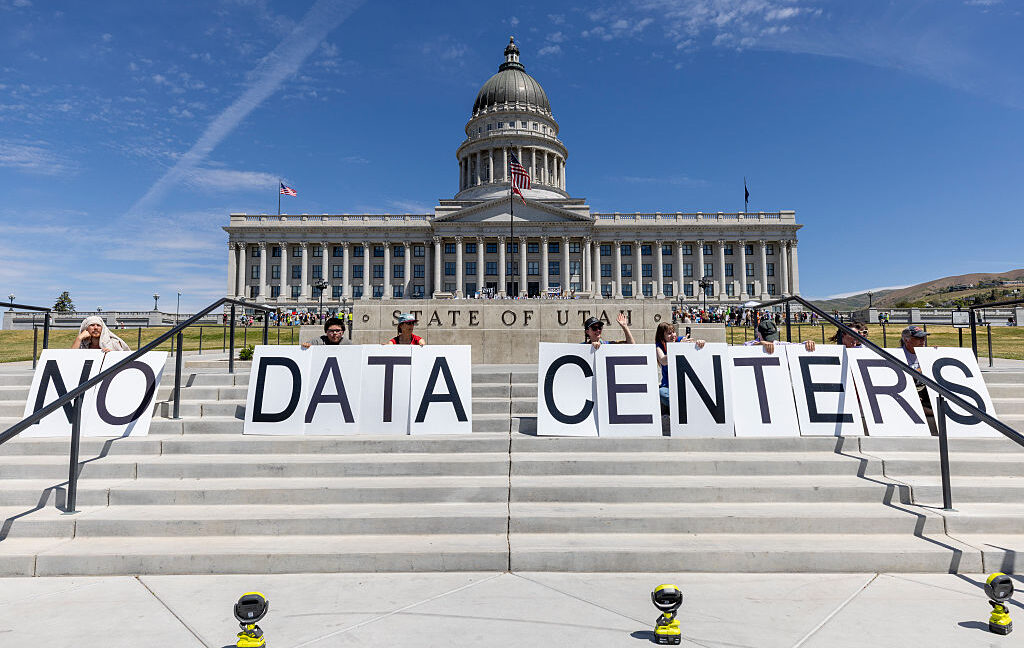
One of the world's biggest data center projects was designed to be nearly three times the size of Manhattan, stretching across multiple Utah sites. But intense local backlash in Box Elder County has now pushed the developer to cut the project plans in half before construction starts.

Residents' top concern was the Stratos data center project draining local waters, and they were willing to pay to protect them, most especially the vulnerable Great Salt Lake. Many locals paid a $15 fee to register comments to block the transfer of 1,900 acre-feet of water from a ranch to the hyperscale data center. Other concerns include electricity bills rising and potential risks to air quality, local wildlife, and land.

Venture capitalist Kevin O'Leary, chair of O'Leary Digital and Shark Tank investor, is behind the construction of the project. He told a local ABC affiliate that he regrets not working with state officials to be more transparent about the project from the beginning.

Read full article

Comments

© Natalie Behring / Stringer | Getty Images News

  •  

Trump admin tries again to revive dying coal industry

On Thursday, President Donald Trump announced his administration's latest attempt to prop up the US coal industry during an incoherent press event that randomly oscillated between energy issues and Trump's fixation with building and renovating monuments in DC. The energy portion of the events was also frequently disconnected from reality.

"Today we're taking historic action to bring down the price of energy and the cost of living for all Americans with the power of clean, beautiful coal," said Trump, apparently unaware that coal is one of the most expensive means of generating electricity in the US.

With wind and solar power getting cheaper, coal has become the second-most expensive way of producing electricity, trailing only the cost of building a new nuclear plant. As a result, no new coal plants have been completed in over a decade, and coal has gone from powering over half the electrical grid to producing only about 15 percent of the nation's electricity. That's before the indirect costs of coal use are considered. It produces the most greenhouse gas emissions per unit of energy, releases dangerous particulates and chemicals into the atmosphere, and leaves behind ash that has high levels of toxic metals.

Read full article

Comments

© Douglas Sacha

  •  

AT&T and Verizon lose Supreme Court case over fines for selling location data

AT&T and Verizon lost an attempt to overturn fines for selling users’ real-time location data without consent, as the Supreme Court ruled today that the Federal Communications Commission process for issuing financial penalties did not violate the right to a jury trial.

AT&T convinced the US Court of Appeals for the 5th Circuit to overturn its fine last year, while Verizon lost in the 2nd Circuit. The Supreme Court took up the case to resolve the circuit split and reversed the 5th Circuit decision in today's ruling, which was 8-1 with Justice Clarence Thomas dissenting.

AT&T and Verizon were fined a total of $104 million by the FCC in 2024 for violations revealed in 2018. The carriers paid their fines and challenged them in circuit appeals courts, where judges’ panels ruled on the cases. Carriers claimed this system deprived them of the Seventh Amendment right to a jury trial.

Read full article

Comments

© Getty Images | Kevin Carter

  •  

Elon Musk tries again to escape FTC audits of X data handling

Critics hope to keep Elon Musk from escaping a strict data-privacy order imposed by the Federal Trade Commission (FTC) shortly before he took over Twitter.

The FTC order placed restrictions on X's data use for 20 years, while requiring regular independent audits and granting the agency authority to request documents as needed to ensure compliance.

The FTC’s action came after Twitter voluntarily disclosed that between May 2013 and September 2019, a coding error accidentally allowed phone numbers and email addresses that users shared for two-factor authentication purposes to be used for targeted advertising aimed at those same users. In a settlement that came just months before Musk's 2022 takeover, Twitter agreed to pay $150 million and to allow the FTC to monitor the platform's data-handling practices until 2042 in order to protect user privacy.

Read full article

Comments

© Anadolu / Contributor | Anadolu

  •  

Cable lobby warns of chaos if FCC doesn't relax ban on foreign routers

The cable industry's primary lobby group is seeking a waiver of the Federal Communications Commission ban on foreign routers, warning of potential chaos if cable Internet service providers can't change some of the components in routers they offer to home broadband users.

In March, the FCC added all consumer-grade routers made at least partly outside the US to its Covered List, which imposes restrictions on devices deemed to pose an unacceptable risk to national security. The change affected virtually all consumer routers, preventing new or changed models from being imported into or sold in the US.

In a petition filed on Tuesday, NCTA-The Internet & Television Association asked the FCC to grant an expedited waiver allowing its members' suppliers to "substitute substrate materials and memory modules in the previously certified routers that are now on the Covered List" as long as the changes "are otherwise consistent" with FCC regulations.

Read full article

Comments

© Getty Images | BernardaSv

  •  
❌