❌

Reading view

NASA updates lander plans for Moon landings, finally solves long-festering Orion issue

During a lengthy news conference on Friday, NASA provided a detailed overview of how it plans to return astronauts to the lunar surface as soon as 2028 as part of its Artemis Program.

Although much of the information behind these plans has been previously reported at Ars Technica and elsewhere, this marked the first time NASA has laid them out in detail and acknowledged some substantial changes in the architecture.

Most notably, for SpaceX's Starship vehicle, the revised plan calls for the Orion spacecraft to dock with the Starship lunar lander in high-Earth orbit before transiting to the Moon. And for Blue Origin, the mission architecture includes four launches of the New Glenn rocket, but no spacecraft-to-spacecraft refuelings. Additionally, the Blue Origin plans allows for the possibility of its Blue Moon lander rendezvousing with Orion in low-Lunar orbit.


Read full article

Comments

© NASA

  •  

Hegseth warns prediction market bets warp military judgment, endanger troops

Defense Secretary Pete Hegseth issued a memo warning military personnel against using nonpublic information to make bets on prediction markets, saying the wagers could give important clues to enemy countries.

"Do Not Compromise Military Operations for Personal Financial Gain," said the subject line of an October 20 memo published yesterday by CBS News. Hegseth's memo was sent to senior Pentagon leadership, Combatant Command leaders, and Defense Department field activity directors.

Hegseth wrote:

Read full article

Comments

© Getty Images | AFP/Martin Lelievre

  •  

Updated Google privacy policy says your Gmail might be used for advertising

Using Google's products and services has always been fundamentally precarious—doing so gives the world's largest advertising company a lot of juicy personal data. Google has long said it won't use the sensitive data from products like Gmail, Drive, and Photos for ad personalization, but a change to the company's privacy policy appears to dismantle that firewall.

On October 16, Google issued an update to its privacy policy, spotted by Android Authority. The ad personalization section used to include a clear limit on data from certain apps. "We don’t show you personalized ads based on your content from Drive, Gmail, or Photos," the document said. Now, Google has updated it with the following language.

Updated language on when your sensitive data might inform ads. Credit: Google

This equivocation opens the door to using data from apps like Gmail and Photos in ads when it's shared with other Google services, and it just so happens Google has a mechanism for doing that, with Personal Intelligence. The company released Personal Intelligence in early 2026, allowing users to hand data from multiple apps to Google AI products. The idea is that the added context from your existing data will lead to better AI answers, but it's also proving to be a privacy minefield.

Read full article

Comments

© Aurich Lawson

  •  

Inside the Pentagon, the pressure is on to find a home for a new spaceport

Leaders in the US Space Force would like to have a new spaceport up and running in four years, adding a third heavy-lift launch site to relieve pressure from bases in Florida and California that have shot rockets into orbit for nearly 70 years.

The obvious problem with that ambition is 2030 is four years away, and Pentagon officials have not determined where the new spaceport should go or how to acquire land for it.

Air Force Secretary Troy Meink first mentioned the service's search for a third launch base in May. A congressionally mandated study of the Space Force's launch infrastructure identified the need for "another site that's capable of heavy and super heavy launch capability," Meink said in a House Armed Services Committee hearing.

Read full article

Comments

© Blue Origin

  •  

Spotify ramps up policy enforcement on family plans

As reported by Music Business Worldwide, Spotify appears to be stepping up enforcement of existing policies regarding Family and Duo subscription plans by requiring users to scan a QR code in person on the plan manager's device in order to maintain access to it. Those who fail to scan the address verification QR code within seven days will see their account demoted to the free tier and be barred from joining any other Duo or Family plan for 12 months.

A Spotify policy on family sharing plans is outlined. Spotify's QR code plan enforcement. Credit: Spotify

Spotify's support documentation verifies the policy after users on Reddit began posting reports of receiving the QR prompt. The enforcement stems from Spotify's requirement that family plan members reside at the same address—a seemingly reasonable policy in concept. But what if you have a child away in college, a spouse who works on the road, or any number of other circumstances that might see families separated by physical distance? The policy could extend beyond friend groups looking to save a buck, affecting actual families who thought they were using the program as intended.

Goldman Sachs analysts, in their October 15 Music in the Air: 10 Years On report, made available by HITS Daily Double, estimate that "a meaningful share of family plan users are not actual household members, but rather friends sharing a plan to reduce costs." The report goes on to add, "We see additional monetization upside from tightening household verification on multi-user plans. Most family plans require members to reside at the same address, but enforcement has been minimal in practice."

Read full article

Comments

© Spotify

  •  

Crows can evaluate visual info twice as fast as mammals

Much of what we know about how a brain makes decisions comes from studying monkeys watching dots. In a task known as a random-dot-motion task, a cloud of flickering specks drifts weakly in one direction while the subject tries to determine whether—and in which direction— it’s moving. The task has shown that in the primate neocortex, neurons gather visual evidence over time, with their firing rates climbing until they cross a threshold, when the animal commits to a decision.

But avian brains don’t have a neocortex, so it wasn’t obvious how they made similar decisions.

“This was the big question,” said Andreas Nieder, a neurobiologist at the University of Tübingen. “How [would] a differently organized avian brain encode decisions?”

Read full article

Comments

© Santiago Urquijo

  •  

Intel gets waiver after worries fuzzy US ban on foreign-made robots may hit fabs

US chip champion Intel was so confused by the US government ban on foreign-made robots that it requested and received a waiver “out of an abundance of caution.” The tech company wanted to make sure that it could continue using certain robotic vehicles in its US chip fabs.

The uncertainty surrounding the Federal Communications Commission ban on certain foreign-made robots was revealed in the agency’s decision to grant Intel’s waiver request. On October 22, the FCC published its order allowing Intel to continue using the foreign-made robots in US semiconductor manufacturing facilities for a period of one year.

The robots in question are automated guided vehicles operating on “tracks or predefined paths” while often requiring operator oversight, according to Intel’s website. They help to move materials and items around within warehouses and factory floors.

Read full article

Comments

© Intel

  •  

RFK Jr.’s vaccine injury clinic could damage NIH hospital, board warns

At a recent meeting of the board that oversees the National Institutes of Health's Clinical Center Research Hospital, chair Jack Leslie opened with cheerful introductions and gregarious chatter—then diverted from the agenda of the regularly scheduled meeting. He spent the next six minutes delivering a pointed rebuke of Health Secretary Robert F. Kennedy, warning that his anti-vaccine activities could tarnish the venerable hospital, often called the "house of hope" for patients with rare conditions or those who have exhausted all other options.

Leslie took issue with a recent stunt Kennedy had pulled at the hospital, which involved making a surprise appearance for a ribbon-cutting ceremony to open his signature vaccine injury clinic. The ceremony included a panel with people claiming to have been injured by vaccines. They sat behind placards reading "vaccine injured" and spoke with Kennedy and other high-ranking Trump administration officials.

Leslie prefaced his comments by noting that some might prefer he not speak out against Kennedy's efforts. "But I think that that would be a failing as an advisory board if we were silent," he said. Leslie also noted that he has no concerns about studying potential injuries from vaccines. "Serious reactions are rare, but real," he said, and people who believe they've been injured should "be taken seriously."

Read full article

Comments

© Getty | Finn Gomez

  •  

Knicks sent employees fake offer of championship rings in phishing test: Report

The New York Knicks organization sent employees a phishing email promising free championship rings in a test of its staff's ability to detect scams, The New York Times reported yesterday. “Congratulations, your Employee Championship Ring is here,” the email sent in late September said, instructing employees to click a link to make a selection from two ring designs.

Madison Square Garden employees who clicked that link "were forced to attend a mandatory cybersecurity class to help satisfy some of [owner James] Dolan’s growing cybersecurity concerns," the report said, citing team sources. Dolan is the owner of the Knicks, the New York Rangers, and Madison Square Garden.

It's common for corporations to send phishing emails to find out which employees don't pay attention to clues that an email is a scam. A cybersecurity-test email often appears to be from the company itself but includes telltale signs of phishing. For example, Ars Technica owner Condé Nast sends phishing-test messages from email addresses with a misspelled domain, "condenest.com."

Read full article

Comments

  •  

Everybody panic: A Valve developer said "HLX" in public

Gamers still hoping against hope for a true follow-up to Half-Life 2 (after so, so many years) may remember last year's flurry of speculation that Half-Life 3 was finally nearing completion. Amid all those rumors, though, we never got any official sign from anyone inside Valve that a Half-Life project was currently in development.

That changed this week thanks to an apparent slip-up during a panel at GameSoundCon, an industry conference devoted to "the art, technology, and business of game audio." In a panel devoted to Valve's use of open audio engines (captured in this Vimeo clip), Valve composer and audio artist Mike Morasky let an interesting string of three letters slip while talking about the way the company implements high dynamic range (HDR) audio:

Our HDR system is basically that's one of the three pieces that come together to make an HDR that you can easily optimize. And in fact, I think Deadlock has their own version of HDR. HLX has its own version, so on and so forth [emphasis added].

"HLX," of course, has been widely reported as the internal code name for Valve's next Half-Life project. The codename has shown up in Valve engine code since at least 2024, but it has never been referenced in public by a Valve employee until now (though Morasky was responsible for a close call in an interview last year).

Read full article

Comments

© knowyourmeme.com

  •  

The reactor meant to showcase nuclear’s comeback keeps hitting problems

US regulators have issued a warning to a nuclear project critical to Donald Trump’s efforts to revive the industry, after a contractor fell into a reactor cavity and a bundle of fuel rods nearly tipped over during refueling.

The US Nuclear Regulatory Commission told Holtec International, a company racing to reopen a shuttered reactor at the Palisades nuclear power plant in Michigan, to address a “chilled work environment” that has made staff hesitant to raise safety concerns without fear of retaliation.

The warning has prompted concerns among critics that financial and political pressures to revitalize nuclear power as an answer to booming AI-driven energy demand are increasing risks of accidents.

Read full article

Comments

© https://www.gettyimages.com/detail/news-photo/south-haven-michigan-the-palisades-nuclear-power-plant-on-news-photo/2203457891

  •  

Ukraine learns to fight without Starlink as Musk plays politics with satellites

Elon Musk’s Starlink satellite service has played a pivotal role in supporting Ukraine’s successful resistance to Russia’s full-scale invasion for years. But with Starlink having become increasingly unreliable due to Musk’s political inclinations and the latest surprise disruptions to service in Ukraine, the Ukrainians and Europe as a whole are now facing urgent questions about how to move forward without it.

As the world’s largest communications satellite network, Starlink can typically support high-speed Internet and data streams for any user or vehicle equipped with a relatively compact Starlink terminal. This has enabled Ukraine to maintain vital communications for both civilian purposes and military operations—and has also expanded the Ukrainian military’s capability to remotely control or provide guidance to drones used in both air defense against Russian attacks and for striking back at Russian targets.

“Starlink currently offers some of the best satellite coverage available, with virtually no competitors when you consider the combination of cost, availability, and ease of use,” according to the head of hardware R&D at the Ukrainian defense company BlueBird Tech, who provided comments to Ars anonymously for security reasons. “In practical terms, the main limitation is the need to position the antenna so it can receive signals from the satellites.”

Read full article

Comments

© Dmytro Smolienko/Ukrinform/NurPhoto via Getty Images

  •  

Review: Crystal Lake suffers a bit from its obsession with Pam Voorhees

Peacock series Crystal Lake doesn’t feel like a Friday the 13th movie when you first press play, even though it’s set up to be a prequel to the original film. (This review includes spoilers of the original Friday the 13th movie but avoids major Crystal Lake spoilers.)

Instead, Crystal Lake strives to build a drama that’s half homage, half uncharted territory, while giving a long-awaited backstory to Pamela Voorhees. The original villain in the first film, Pam Voorhees, shocked audiences in 1980 by popping up out of nowhere in the midst of a brutal camp counselor killing spree, then confronting the final girl with a Norman Bates-like delivery of the movie’s chilling tagline, “Kill her, mommy,” using the voice of her drowned son, Jason.

Betsy Palmer as Pam Voorhees in Friday the 13th. Credit: via Paramount Pictures
Linda Cardellini as Pam Voorhees in Crystal Lake. Credit: via Peacock

Although the hockey-masked killer, Jason Voorhees, became the horror icon at the center of the franchise, his mom, Pam, continued to fascinate fans, who knew very little about her. Beheaded in the first film after just 13 minutes onscreen, her spirit would occasionally appear in later films, but the original actor, Betsy Palmer, who portrayed Pam refused to return, largely because the character has no depth.

Read full article

Comments

© via Peacock/Matt Infante

  •  

Rocket Report: SpaceX says no thanks to military launches; Spanish rocket nearly ready

Welcome to Edition 9.16 of the Rocket Report! Lots of SpaceX-related news this week including a couple of Thursday shockers. In one story, the company told the US Space Force thanks, but no thanks after being offered three military launch contracts. Then, on the civil space side of things, SpaceX's Starship may required up to 22 refuelings to support a lunar landing, a NASA safety panel said.

As always, we welcome reader submissions, and if you don't want to miss an issue, please subscribe using the box below (the form will not appear on AMP-enabled versions of the site). Each report will include information on small-, medium-, and heavy-lift rockets as well as a quick look ahead at the next three launches on the calendar.

Miura 5 getting closer to launch. PLD Space says its Miura 5 rocket, due to undertake its inaugural launch next year, is nearing final integration, Aviation Week reports. The rocket is one of three Miura 5s the company has already manufactured, with the other two designed to qualify key system elements, CEO Raúl Torres said in an October 19 program update. PLD Space now targets a first flight of the small-lift vehicle before mid-2027.

Read full article

Comments

© Reaction Dynamics

  •  

Switch 2 security takes a hit as hackers unlock homebrew access

A security researcher has demonstrated a software-only partial jailbreak of the Switch 2, gaining "userland" access that he says "lets us run homebrew, reverse engineer and mod Switch 2 games, back up save files off the Switch, and access most of the Switch 2’s peripherals through MMIO."

The hack relies on the original Switch version of SmileBasic 4, the latest in a long-running series of programming environments and interpreters that run on Nintendo hardware. The so-called "tethered" hack also requires access to a macOS or Linux PC on the same network to run a node.js package that helps enable privileged system access.

Researcher Sammy Hajhamid writes that he used OpenAI's Codex to poke at SmileBasic's language interpreter, using a custom harness that could send USB commands to the system and view results via HDMI (as well as power cycling via a Bluetooth light switch flipping device). After "substantial effort for ~2 weeks," that harness discovered a 32-bit integer overflow that occurs when removing items from an array in SmileBasic. That error gives access to an array pointer, which in turn allows read-and-write access to portions of system memory.

Read full article

Comments

© Pepsipu.com

  •  

Moderna and Merck say their mRNA cancer vaccine cut death, recurrence by 42%

Personalized mRNA vaccines against melanoma—the deadliest form of skin cancer—reduced the risk of death or recurrence by 42 percent compared to standard treatment in a late-stage trial, pharmaceutical partners Merck and Moderna announced Thursday.

The results are a significant advance in melanoma treatment; Merck and Moderna are already engaging with regulatory authorities to get the vaccine approved. More broadly, the vaccine's success bolsters hope that mRNA vaccines and individualized cancer-targeting medicines offer a new paradigm for cancer therapies.

"From the beginning, we believed mRNA technology could make it possible to develop cancer treatments uniquely matched to each patient’s tumor," Moderna CEO Stéphane Bancel said in a statement. The trial results "mark a defining moment for that vision and show what’s possible when we rethink how medicines are made." They also "reinforce our conviction that mRNA has the potential to fundamentally change how we treat cancer," he said.

Read full article

Comments

© Getty | Nikolas Kokovlis

  •  

Latest estimate for Starship launches required to support a Moon landing? 22.

NASA does not have, nor want, nuclear weapons. But when it comes to a particular metric that is part of the Artemis Program to land people on the Moon, NASA guards a particular number like it is trying to prevent outsiders from cracking nuclear codes.

I am speaking of the number of Starship launches required to fuel a Starship-based lunar lander in low-Earth orbit such that it can fly out to the Moon, land there, and return to lunar orbit.

This number has been a moving target over the years. The general response from NASA has typically been, 'We don't know for sure, so we're not going to say.' In 2023, for example, the then-director of NASA's Human Landing System, Lisa Watson-Morgan, told Ars, "We have a general idea, but I’m reluctant to say exactly what that is."

Read full article

Comments

© SpaceX

  •  

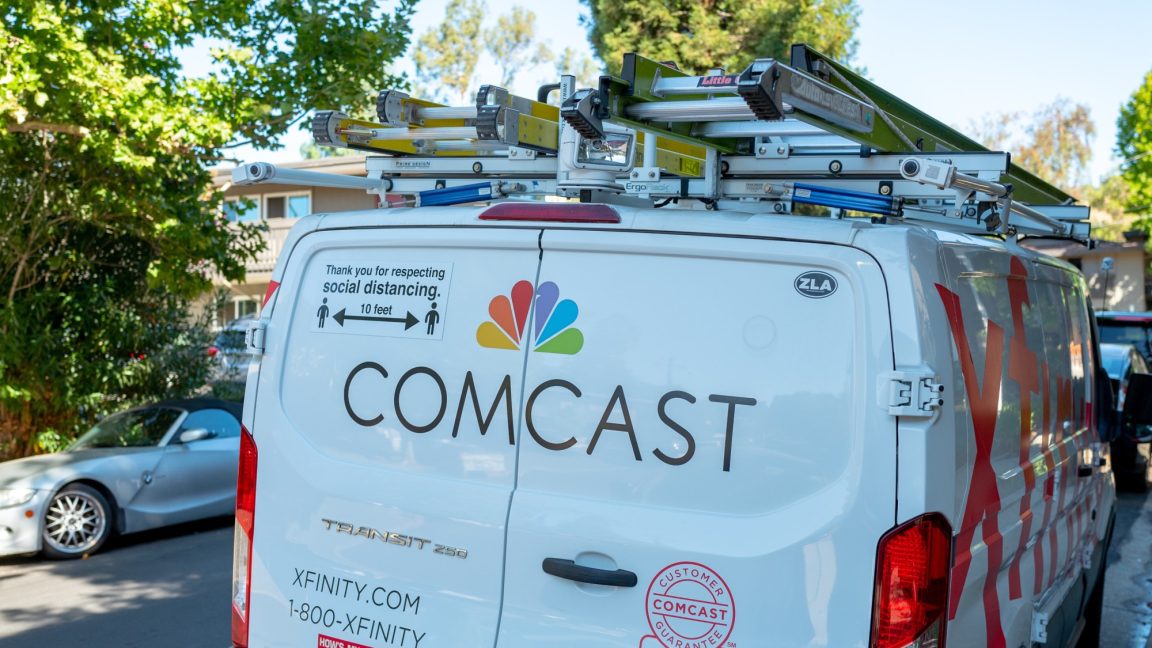
Comcast loses more customers, claims other ISPs' cheap prices are "irrational"

Comcast reportedly plans significant job cuts in its cable division as the firm continues to lose residential broadband and TV customers. Comcast lost 144,000 residential broadband customers in Q3 2026, up from a 91,000-customer loss in the same quarter a year ago, the company said in its earnings report today.

Comcast historically capitalized on a lack of competition for high-speed wired broadband. But now it faces stronger competition from fixed wireless providers and from fiber providers in parts of its cable territory.

"Fixed wireless remains aggressive and continues to take share, while fiber construction remains elevated, with pockets of irrational pricing and promotional activity," Comcast co-CEO Mike Cavanagh said today in an earnings call.

Read full article

Comments

© Getty Images | Smith Collection/Gado

  •  
❌